 |

Wednesday, July 30, 2008
A ruling by a federal appeals court yesterday said that the Whole Foods-Wild Oats merger, which has already closed four Wild Oats stores (including the one in Portland) and "reflagged" 27 others as Whole Foods, may have taken place without adequate consideration of the effect on the marketplace for natural and organic foods. The Federal Trade Commission, which brought the request to block the merger, "argued that the Whole Foods' takeover would limit competition and increase prices" among people who buy natural products, according to today's New York Times. Problem is, the merger has, for all effective purposes, already happened (witness the shuttered store on Marginal Way). "The eggs are already scrambled," antitrust lawyer Richard E. Donovan is quoted as saying. "What are you going to do?"
First things first, a correction: My too-fast fingers misspelled Cyrus Hagge's name in my piece about reporting operations on the Hill. My apologies to Mr. Hagge. Secondly, some others have weighed in on their thoughts about the Observer, including former MHNO board member Heather Curtis. "In my personal opinion, the Observer exists to provide a public forum," she wrote in February (while she was still on the board). "Although a cherished right of the people, freedom of the press is different from
other liberties of the people in that it is both individual and institutional.
It applies not just to a single person's right to publish ideas, but also to the
right of print and broadcast media to express political views and to cover and
publish news. A free press is, therefore, one of the foundations of a democratic
society, and as Walter Lippmann, the 20th-century American columnist, wrote, 'A
free press is not a privilege, but an organic necessity in a great society.' Indeed, as society has grown increasingly complex, people rely more and more on
newspapers, radio, and television to keep abreast with world news, opinion, and
political ideas. One sign of the importance of a free press is that when
antidemocratic forces take over a country, their first act is often to muzzle
the press." "Obviously, we will resist attemps to turn the Observer into just a newsletter for the MHNO Board rather than a robust, vibrant community newspaper," she added in an email this week.
Tuesday, July 29, 2008
It’s an article of faith among art
organizations that public art is unquestionably a good thing. The fact is, most
public art is far from a good thing; most of it is plain awful.
Making art good enough to hold its own in a pubic space is special skill, and most artists, even very good artists, can’t do it. Even if
they could, most committees, and Portland’s
is no exception, can’t make a decision for quality art, even if they were
offered it. Horses, camels.
For proof, one need look no farther than around the town. There is, as far as I know,
no good public art anywhere in the city, with the possible exception of some stones arranged on
the Waynefleet campus. The Mierle Ukeles piece at MECA is a obvious throw-together.
The recent additions are at best banal and at worst silly. There is some humor
value in the accidentally autoerotic (at least when viewed from the west)
statue of the fireman in front of the firehouse on Congress Street, but otherwise there is little to lift one's spirits.
The Portland
public art committee has good people on it, but it the whole idea of a committee selection process is flawed. Percent for
art has left bad piece after bad piece around the state, all chosen by committees, most of whom were unfamiliar with art at all. Go look, you’ll see
what I mean. With the exception of a couple of pieces by Roger Majorowicz, who
has a flair for making art that is both interesting and accessible, most are
prime examples of what James Wines called ‘plop art,’ or the ‘turd in the
plaza’ effect.
Good artists can’t always make art for public spaces.
There’s an Isamu Noguchi in lower Manhattan
that just shouldn't be where it is. For a while there was a David Smith, a great sculptor
by any measure, at Lincoln
Center and it looked
awful. Mark di Suvero, who depends on huge scale for much of his work, can’t
always get it right. Anyone who saw the Richard Serra ‘Tilted Arc’ before it
was removed from the plaza it occupied could see it was wrong for that spot.
During that same period there was another Serra in park-like area near the
Holland Tunnel that was great. His big piece outside the Carnegie
Museum in Pittsburgh is one of the best public
sculptures I’ve seen anywhere.
It’s best to get a good one that works where it is. Good art
isn’t always popular, but over time it
grows on the passers-by. The big Picasso horse in Chicago was like that. After a few years it
was embraced by the community. I’m no great fan of Picasso, but that is a great
sculpture.
Mediocre or poorly-sited work has the opposite effect. It
may generate a little early opposition, but over time it just looks like
nothing. It’s better to have nothing than to have something that looks like
nothing. These are the only art works some people will usually see in their
lives, and to have it be something pallid is a great shame.
Here are a few good public art pieces in Maine, in no particular order:
Sculptures by Richard Serra and Sol Lewitt at Colby College
Museum of Art, Waterville
Two pieces by Roger Majorowicz, one in downtown Waterville and another at
a school in Gardiner.
I can’t think of any more.
I'm getting a feeling of deja vu. Jamilla El-Shafei, of the Kennebunks Peace Department, is helping to organize a weekend protest march to the Bush family compound in Kennebunkport. Bush will visit Kennebunkport on Saturday, August 2. The usual suspects will be present: Code Pink, Maine Peace Action, Veterans for Peace, and Carlos Arredondo, the father of a slain soldier who died in Iraq four years ago. My questions, asked in earnest, are: Are these protests drawing new attendees every time? What do they accomplish? Do observers start to tune them out after some time? I'm not sure. My call is in to Jamilla to get her take, which I'll post here.
Monday, July 28, 2008
An independent film, co-written by Kennebunk resident Steve Hrehovcik, filmed some scenes in Kittery over the weekend. 27 Down,
due out in 2009, tells the story of a Boston cop who gets involved in a
hit-and-run and then moves to the fictional town of Canada, Maine
(Hrehovcik is obviously fascinated by
the abudance of shared place-names in Maine; see below). The crew, led by director
John Depew, shot some bar and crowd scenes; one extra documented the experience on her personal blog. They also filmed a scene in the Kittery Police Station. Hrehovcik (pronounced Hero-check) and his son, Josh, also write and produce a humorous series called "Bruce McToose: Intrepid Traveler," which takes its somewhat hapless title character to places throughout Maine that aren't quite what (or where) he thinks they are. The first episode, "Norway," has Bruce McToose asking locals where he can find the fjords. New episodes will be online soon.
Friday, July 25, 2008
Um, excuse me. Yesterday I saw some dude walking around the Old Port with a large snake wrapped around his neck, but I didn't think things were getting this out of control. 
Via StrangeMaine, obvi.
Thursday, July 24, 2008
It’s in the nature of newspaper scheduling that you don’t always
get to write about those interesting events, so I haven’t had the time or
column inches to devote to a veteran painter of considerable interest, Charles
DuBack at Jameson Gallery in Portland.
His show ends this weekend, July 26, so here’s a somewhat belated appreciation.
 I never saw his work in New York, although he had been part of the
scene there for a long time when I first got there. If memory serves, I first
saw his work shown by the late Don Slagel in a little gallery in Waldoboro. I recognized
right away that here was an artist who had drunk at the fountain of modernist
art with real gusto. He was, and remains, at the age of 82, a believer in the
lessons of Matisse and the other pioneers.
His recent work skirts the edges of true abstraction, with references
that make his work both a picture of something it isn’t, while building
collection of colors and shapes that are their own content. The anchor of
everything he does is color. He uses brilliant hues and strokes, sometimes
creating an image and others creating a setting for a barely suggested
narrative. As with most good modernist art, there are layers of experience in
each of his paintings that only become apparent with time. This is a show to
visit slowly.
The Jameson Gallery is at 305 Commercial Street in Portland
Wednesday, July 23, 2008
More Avesta Housing news, strangely. They cut the ribbon today on the Pearl Place Apartments, "Maine’s first Leadership
in Energy and Environmental Design (LEED) certified affordable housing development," according to a press release sent out today. The 60 (cat-friendly) units, located at Oxford and Pearl streets, are also endorsed by the U.S. Green Building
Council. They're listed for rent at between $639-1064/month, with income limits. If future tenants are properly educated about the green aspects of their digs, sustainable and affordable housing developements are the next step toward ensuring that "eco-friendly" doesn't mean "elitist."
Tuesday, July 22, 2008
This didn't quite fit in Sibilance this week, but we didn't want you to miss out:
F The
Portland music scene is getting all kinds of Web-friendly. On July 24, Spencer Albee
and Dave
Gutter of Rustic Overtones (and As Fast As and Paranoid Social Club) will join Bull Moose
co-owner Chris
Brown as part of a live chat hosted by the Bull Moose group on Facebook.
They’ll answer any questions you throw at them from 4:30 to 5 pm. Any Facebook
member can view the chat, though only Bull Moose group members can ask a
question, so join the group in advance if you want in. And don’t think this is
a totally naked marketing thing — Bull Moose didn’t even start the Facebook
group. Some high school kid named Steve Morse did. He just really likes Bull
Moose.
This didn't quite fit in Sibilance this week, but we didn't want you to miss out:
F The
Portland music scene is getting all kinds of Web-friendly. On July 24, Spencer Albee
and Dave
Gutter of Rustic Overtones (and As Fast As and Paranoid Social Club) will join Bull Moose
co-owner Chris
Brown as part of a live chat hosted by the Bull Moose group on Facebook.
They’ll answer any questions you throw at them from 4:30 to 5 pm. Any Facebook
member can view the chat, though only Bull Moose group members can ask a
question, so join the group in advance if you want in. And don’t think this is
a totally naked marketing thing — Bull Moose didn’t even start the Facebook
group. Some high school kid named Steve Morse did. He just really likes Bull
Moose.
Most 20th-anniversary celebrations are a little more involved than this: 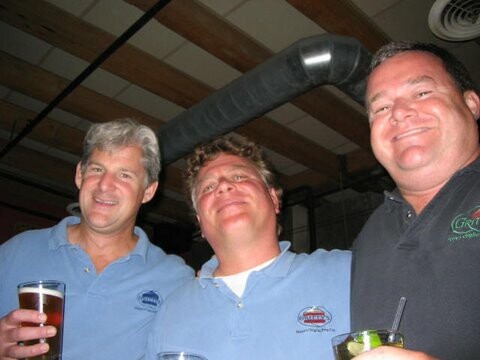
The Gritty McDuff's folks knew 2008 was their 20th anniversary year. But the word on the street is that yesterday a Gritty's staffer (who shall remain nameless to protect the guilty) realized that July 21 was the actual, on-the-day, 20th anniversary of the founding of Gritty McDuff's. So something had to be done. Raise a pint? You bet! There in the photo are Gritty's founders Richard Pfeffer and Ed Steb | |