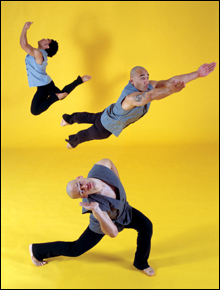
BLACK GRACE DANCE COMPANY: The core
language is a display of unrelenting male
power. |
Modern dancers who aren’t tethered to a specific technique can forage the whole world for useful movement and effects. We saw three completely different examples recently.
The week before last, Lorraine Chapman’s Here to There, sharing a program with Kinodance at the ICA (sponsored by CRASHarts), took an affectionate look at some pop-culture clichés, with sideways pokes at America the Brave. Chapman invited Marcus Schulkind and David Parker to share choreographic responsibilities with her. It was Parker’s campy sensibility that prevailed in the piece, but Schulkind’s thoughtfulness and Chapman’s physical nerve made for a seamless mix.

The dance opened with a solo for Chapman (by Parker) to John Philip Sousa marches and a tarantella. Chapman has the unusual gift of stylization. She can make you see a drum majorette, a music-hall floozie, a marathon runner, and a dozen other tintypes with a tilt of the shoulder, a turned-out heel, a well-placed glance. The solo was long, but before you could tire of it she’d introduce some new take on the music. At some point she was singing — out of breath but full-out — “There’s no business like show business,” to the tune of “The Star Spangled Banner.” The point is not just to make fun of all this iconography but to celebrate spunkiness and the persistence of belief in the face of perversity.
To a fragment of Arvo Pärt’s Sanctus, a line-up of eight more dancers appeared in a glum procession, with their arms draped over poles that rested on their shoulders. David Parker crossed the stage in front of them, to declare in the voice of destiny: “Long before the dawn of time . . . man danced.” The dancers turned their burdens into walking sticks and swung into a perky chorus line.
From there, the whole thing tumbled into a show-biz crazy quilt, with most of the familiar items turned inside out. Group line-ups in modes from funky to flagrant wove it all together. There were fake jungle dances, a tap dance instantly mangled, a hearty singing of “Over the Rainbow” accompanied by melodic thumps to the thighs and chest. Shreds of Fred Astaire, Esther Williams, Yma Sumac, Jimmy Cagney, Georg Frideric Handel, H.M.S. Pinafore, and who knows what else sped through the proceedings and vanished again.
The chorus ended up on their knees, stripped to their skivvies, possibly praying, possibly sobbing, but you could imagine them getting right back up and starting another stanza.
Kinodance treats movement as an equal element in a multimedia environment. Each work emerges from several collaborators and explores some particular combination of technological resources. Both pieces at the ICA ended up a long way from their historical triggers.
Fuse, choreographed by Alissa Cardone and Ingrid Schatz, was inspired by the Lumia box, an early-20th-century camera obscura, and by other inventions for creating designs with light. Music was provided by Roger Miller on a prepared upright piano that had the front panels removed so we could see him twanging and thumping on its innards.
Mysterious figures wearing mismatched costumes (the choreographers and Stephanie Lanckton and DeAnna Pellecchia) glimmered and went invisible in a 12-foot room with a scrim for a front wall. Kathy Couch’s atmospheric lighting and projections caught them crouching inside the room, suspended on its roof, hanging from the ceiling and clambering up one perforated wall. Perhaps at random, one or two of the figures slipped out to wander through the stage at large or lurk indecisively near a ladder of neon.
Sometimes I thought they were just experimenting with how their simple moves — hip wiggles, shoulder stands, folded shapes — would look under the lighting activity. Other times the movement suggested dramatic encounters. Characters seemed to stalk other characters, capture them, partner them in shadow duets. A woman ricocheted off the walls; I thought of Lillian Gish trapped in a closet in Broken Blossoms.
A program note informed us that the collaborators used a film script to make the piece, but I saw it more as a collection of scenes from German expressionism and silent movies than as a connected narrative.
Behemoth, choreographed by Cardone, filmmaker Alla Kovgan, and designer Dedalus Wainwright, seemed nebulous as “an evocation of a color organ.” Musicians, artists, and mystics throughout history have tried to correlate light and sound. Father Louis Bertrand Castel’s color organ, one of many such experiments, used colored glass and a complicated apparatus to create visible music when the organist operated the keys.
Two big objects hung over the stage, suggesting the vertical structures of organ pipes. Projections flickered over them, but they didn’t emit specific colors. Jessica Rylan sat at a console and produced a series of irritating electronic noises — steady-state screeches and yowls and static. Alissa Cardone roamed the space, making spidery gestures, wearing a mini version of an 18th-century ball gown. Sometimes the sounds seemed to propel her, sometimes not.
