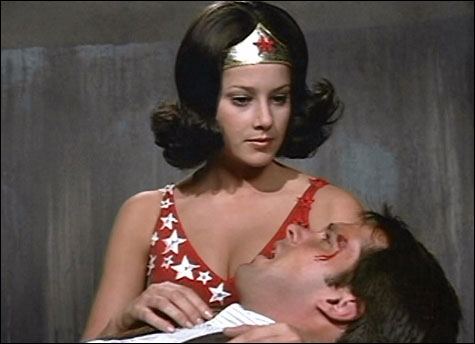
Debra Winger as Wonder Girl |
Back in the eighties, Debra Winger was dubbed an It Girl as John Travolta’s bull-riding wife in Urban Cowboy, and her subsequent Oscar nominations — for her role as a strong-willed mom in Terms of Endearment and a love-struck idealist in An Officer and a Gentleman — were coupled with a public image roughly parallel to twenty-something media targets/darlings of today. Except instead of checking into rehab, the actress spoke her mind. In 1995, on the heels of another Oscar nomination (for Shadowlands) she quit show business and focused on raising her sons.“It’s that old adage, ‘whatever they ask, answer what you want,’” says Winger, whose first book, Undiscovered,doesn’t harp on Hollywood or even the globe trotting she’s been doing for Sight Savers International, which she’s involved with because of an accident involving a truck and a troll costume that left her blind for ten months at the age of seventeen. Instead,the title refers to a discovery of self.
Alternating essays with poems, and examinations of her inner journey with bitterly funny anecdotes (she embarrasses a director with a particularly choice swear word), Winger has succeeded in compiling thoughts on aging, motherhood, and the reasons we walk on a wire, with insight that never comes across as pompous: she asks as many questions as she answers. On a sweltering June day, in between grabbing aspirin and groaning at an incessantly ringing phone, she tells me why.
In Undiscovered, you refer anonymously to rude directors and ex-boyfriends. Did you feel you had to make an effort not to offend people?
No. That’s really a great question because in public I can say ten great things and one, I think, funny thing, which may be a little acerbic. I was talking to Whoopi Goldberg yesterday — I started out in standup comedy and she was coming up in some clubs in San Francisco when I was working at some comedy clubs in LA. When you’re a comedian, you never get quoted unless it’s really really rank, you know? You can have a forty five minute routine where you jab at every one, and no one quotes you unless it’s extremely funny. But if you’ve made your way being something else, like an actress…look at these stupid things I say, they’re not serious.
Such as your book ‘outing’ Jack Nicholson for loving prostitutes, which was all over the news?
Richard Johnson originated this thing which is one of those bad snowballs. First of all, I never used the word. Secondly, I talked about visiting brothels. He and I together because we were in Berlin in the early eighties — we went to brothels because that’s where you get the best food. Had Richard Johnson bothered to talk to me about the food you get in a brothel, I think it’s a much more interesting conversation.
Besides that, you don’t write about anything one would expect from a celebrity memoir, which is pretty refreshing.
Then you’re who I’m writing for. I’m just so tired of those same questions and I can’t imagine why anyone else isn’t. In the forties we had fan mags and we had the press. For some reason we have come to refer to fan mags as press. It’s celebrity…you know…it’s…
