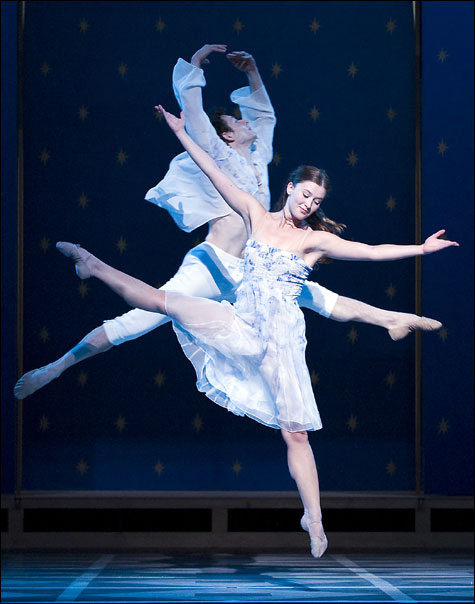
ROMEO & JULIET The dances seemed repetitious and less interesting than the way he staged
the story and the characters. |
Mark Morris’s displaced romanticism is the perfect high-art solution for our times. Morris believes in happy endings, but he probably doesn’t trust them. He reveres great music but shields us from its passions with caricature and formal gesture. In his new production of Romeo and Juliet, the subject is love, but the word always has quotes around it. Widely celebrated in advance of its premiere last weekend at Bard College, this Romeo carries a cautious subtitle, directing us not to take the Shakespearean icon literally. Romeo & Juliet, On Motifs of Shakespeare is less of a statement than a supposition: what if we did it a different way?
Two years ago, Princeton musicologist Simon Morrison discovered that the majestic score of Sergei Prokofiev, which has fueled many balletic interpretations, had been doctored to satisfy the guardians of Soviet political correctness. Prokofiev intended something more modest and less traditional, something that overturned Shakespeare to grant the star-crossed lovers a life together — or an afterlife.

The composer practiced Christian Science, and his ambiguous 1935 ending may have transported the protagonists from the material plane that constitutes temporal life to a place where there can be no suffering or separation. Perhaps the spiritual tinge of this reversal offended Soviet atheism. It’s not clear how Prokofiev and his collaborator, theater director Simon Radlov, would have translated their philosophical and social conception if the authorities had allowed it to be produced. By the time the revised music was choreographed five years later, by Leonid Lavrovsky for Konstantin Sergeyev, Galina Ulanova, and the Kirov Ballet, the lovers died tragically and the feuding families reconciled over their bodies, as Shakespeare decreed.
Morrison reconstructed the original score, which is thinner in orchestration than its puffed-out Sovietized version and differs in many other respects from the ballet we know. I’ll leave it to the music scholars to trace the restorations and diversions, but the dance aspect is original with Morris. This is not a period retrieval, like Millicent Hodson’s 2005 constructivist interpretation of Le pas d’acier, another Prokofiev score that was never produced as he originally intended. Instead, Morris has choreographed a dazzling theater piece that comments on Shakespeare’s play, with previous balletic renderings of the play and the whole genre of large-scale 19th-century story ballets in mind as well.
Without painted backdrops or elaborate scenic trappings, the ballet takes place inside a room, a wood-paneled set with sections that open to allow entrances and exits. Banks of stage lights are visible above it, and small boxes are moved in and out for furniture. Dollhouses designed like villas and a church signify the marketplace in Verona. The costumes are different for each individual and preserve only the broadest class distinctions. This theatrical anti-realism in design (scenery by Allen Moyer; costumes by Martin Pakledinaz; lights by James F. Ingalls) is carried through in the movement. The characters taunt each other with authentic lewd gestures — and fight simulated duels with wooden swords.
Morris’s central couple (Noah Vinson and Maile Okamura on Saturday night) seem recessive, almost childlike, pulled apart by their elders, their friends, their obligations. In between the long duet scenes, they seem suspended in indecisive reveries. Morris draws attention away from their drama with busy crowds and intriguing asides. The nurse (the wonderful Lauren Grant) is not only young and sprightly, she has her own servant (Samuel Black), whom she allows a quick squeeze now and then. Her life, in other words, doesn’t revolve entirely around Juliet.
Morris has talked about the destructive power of authority in this story. The Prince of Verona (Joe Bowie) arrives to the most menacing music in the score. He sweeps in and out repeatedly, and the populace marches after him with stiff militaristic gestures. The Capulet parents (Megan Williams and Shawn Gannon) are lusty and crafty — eager to marry off Juliet and get on with their own pleasures. The senior Montagues (Teri Weksler and Guillermo Resto) wring their hands and flaunt their voluminous black robes.
At the same time, the younger gentry and the townspeople fraternize on an equal footing. Both Tybalt, Juliet’s cousin, and Paris, her would-be fiancé, mingle freely with the hoi polloi. Paris even brings his raunchy girlfriends and drinking buddies to entertain on the day of the wedding. The Capulets may be rich, but Juliet’s nurse is serving drinks during the ballroom scene, as if the house didn’t have a big staff on hand to do that chore.
Romeo & Juliet has a lot of plot to get through in three hours, and a lot of music. Morris’s dances seemed repetitious and less interesting to me than the way he staged the story and the characters. Tybalt and Mercutio are played by women (Julie Worden and Amber Darragh), so the audience unavoidably reads them with the double entendre of travesti. Clockwork mime gestures often substitute for naturalistic acting.
