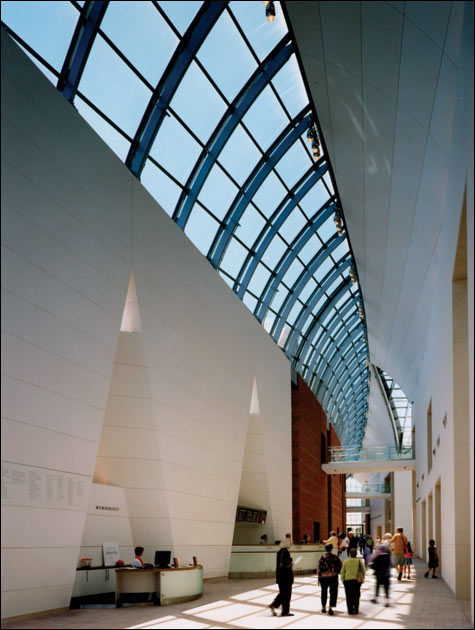
The Peabody Essex's atrium
|
Could the Peabody Essex Museum be the Boston area’s most exciting art museum right now? It’s a question nobody would have asked five or 10 years ago. But a string of excellent shows — in particular this past summer’s landmark Joseph Cornell retrospective, but also the current “Wedded Bliss” — has placed the Salem museum squarely in the same league as the Museum of Fine Arts, the Institute of Contemporary Art, and other top-rank museums around the country.The transition, which Boston is only beginning to recognize, has been some 15 years in the making, including a merger, a building expansion, more exhibitions, and increasingly ambitious shows. The Cornell show, Peabody Essex chief curator Lynda Roscoe Hartigan told me this past December, “really is about signaling, in as direct a way as we could think of, that we mean business about doing work in the modern- and contemporary-art arena.”
It’s a striking transformation. The Peabody Essex evolved out of the East India Marine Society, founded in 1799 as a repository for cool stuff brought back by Salem’s China trade. In 1992, it merged with its neighbor, the Essex Institute, a locally focused antiquarian society dating back to 1821.
The new Peabody Essex Museum was the sole-surviving Enlightenment-era cabinet-of-wonders museum from the early American republic, but it felt dark, dusty, and stodgy. When Dan Monroe arrived from Oregon’s Portland Museum of Art to become director in 1993, it was a backward-looking, colonial institution concentrating on New England, Native American life, natural history, and the cultures Salem touched via the China trade.
Between 1996 and 2003, Monroe tripled the museum’s operating budget, and led a capital campaign to renovate and expand the museum, which culminated in the opening of a new Moshe Safdie–designed facility in 2003. It offered new galleries, a soaring glass atrium, and a 200-year-old merchant’s house that was shipped from China and reassembled on the museum campus.
Signs of a new curatorial vision could be detected in such exhibits as a 1997 show that mixed works by contemporary Native Americans with historical Native works from the museum’s collection. Barbara O’Brien, director of Simmons College’s Trustman Art Gallery, says a turning point came with the renovated museum’s 2003 opening exhibit, “Family Ties: International Contemporary Artists Interpret Family.” In it, freelance curator Trevor Fairbrother — a former contemporary-art curator at Boston’s MFA — assembled a “provocative” and “subtly conceived” (according to The New York Times) but accessible theme show of contemporary art by Andy Warhol, Nan Goldin, Kerry James Marshal, Zhang Huan, and others.
“What he created was a model,” says O’Brien. “He both expanded the potential audience, but maintained the connection to scholarship and research. I think that’s the show that rebranded the museum.”
The year 2003 also saw the arrival of Hartigan — an expert on, among other things, Cornell and folk art. She and Monroe brought in new staff and reenergized veterans, giving them the backing and encouragement to take risks and soar. They’ve pulled off a marvelous pivot, turning a collection of colonial trophies (world-class collections of Japanese, Chinese, Korean, Oceanic, and Native American art, plus American costumes, fine, folk, decorative, and maritime art) into the foundation of a deeply engaged, internationally attuned, progressive contemporary museum.
