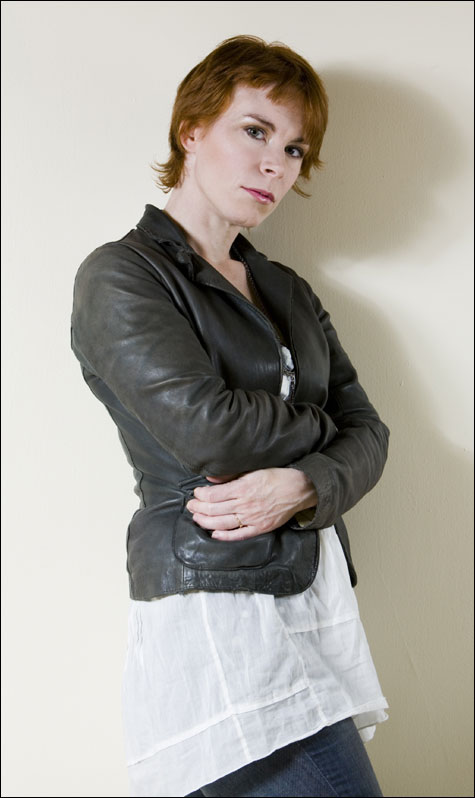
Tana French’s background as an actor has made her value character — which explains the psychological depth of her wonderfully literate crime fiction. In town to read from The Likeness (Viking), the follow-up to her Edgar-winning debut, In the Woods, the Dublin-based author discussed means, motive, and opportunity.
In both your books, backstory plays a major role. Do you think the past determines the future?
I think there is a context in which life takes place. I’m a big believer in crime being shaped by context. Not in any way that people aren’t responsible for their crimes, but an individual’s psychology shapes whatever goes on around them, whether it reaches a moment of violence or not.
Backstory seems important to your protagonists, as well.
In In the Woods, Rob Ryan’s mind was cracked straight across at the age of 12, and when the book starts, he’s actually doing pretty well. He’s got a career he loves, he’s got a partner and best friend, but when pressure is brought to bear on this crack, it starts to deteriorate — not just his memory but his whole idea of who he is. Cassie [Maddox, Rob’s partner and the protagonist of The Likeness] was orphaned very early, and her life has been creating roots.
To an extent, it seems to me that for people who were interested in these questions of action and consequences, of identity and past and present, it would be natural to become detectives. Because as a detective you’re doing something very much like what mystery writers and mystery readers do. You’re fascinated by the process of discovering answers — not just by the answers themselves, but by the process. There’s an interplay between who they are and what they do, and that works both ways. The strangeness in their pasts comes through in their identities and what they do.
Each of these books has a different protagonist, and the one you're working on now features a colleague of Rob and Cassie, Frank Mackey. Does this mean that each character has only one story?
I know the standard thing is to write a series of books about the same detective. But what I’m interested in are those crucial turning points in people’s lives where you know that whatever you decide in that situation, you’ll never be in the same place again. In the Woods was that for Rob — the decisions he made have shaped the rest of his future, probably not in very healthy ways. The thing is, people only have a certain number of turning points. So I could keep dumping this poor guy into high-stakes, life-changing situations, or I could dilute it and write about less important situations in his life, which I wasn’t sure I wanted to do. I kind of envisioned Rob spending the next couple of years trying to patch himself together. I wasn’t sure he’d have that much of a story. Or I could change the narrator. Cassie is interesting and hadn’t had a chance to tell her story, so I wondered what might happen in her life, what she might be doing next.
