ANOTHER EVENING: Bill T. Jones’s new work extrapolates from familiar Lincolnian issues to the
still-smoldering troubles of our time. |
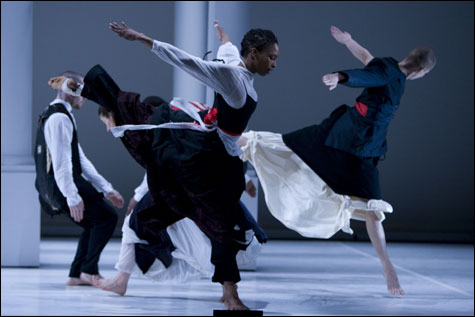
Bill T. Jones/Arnie Zane Company’s Another Evening: Serenade/The Proposition is an elegant layering of dance, design, music, and words — and like its title, it doesn’t necessarily convey one overall message. Shown last weekend at the Institute of Contemporary Art, the hour-long work is the first in a projected trilogy built around Abraham Lincoln’s bicentennial birthday, which will be celebrated next year.Bill T. Jones doesn’t list himself as choreographer for Another Evening and he doesn’t dance in it, but as artistic director and no doubt conceptualizer, he’s imprinted the piece with his wide-ranging civic concerns. Of all dance artists, no one is engaged more seriously with the moral and social crises of our culture. This new work, which he premiered last summer at the American Dance Festival, extrapolates from familiar Lincolnian issues — slavery, racial discrimination, the divided Union — to the still-smoldering troubles of our time: all of the above, plus cultural polarization, violence, international power games, endless war and destruction. Jones doesn’t suggest a solution to any of this except, possibly, a new coalition of difference.
It isn’t his way to name his issues directly. AIDS/HIV, one of his subjects for years, isn’t explicitly mentioned, but the piece is dedicated to the company’s long-time collaborator, actor Andrea Smith, who died of the plague in July. When one of the dancers was carried out by his companions, I remembered a similar cortège for an infected dancer in Jones’s 1989 D-Man in the Waters.
Although there’s dancing all the way through it, Another Evening feels more like a polemic, or a very advanced form of pageantry, where the goal is to bring people’s attention to big ideas in a positive way. It’s a signifying piece, a testimony, a memorial, rather than a revelation.
Two podiums flanking the stage are occupied by a singer (Lisa Komara) and a narrator (Jamyl Dobson), who deliver chapter and verse. The dancers walk out, do their phrases assertively, and leave, with every point made, every image crystallized. Dobson reads pieces of 19th-century oratorical uplift and instruction interspersed with thoughts about the meaning of history from what may be Bill T. Jones’s autobiography.
The set, by Bjorn Amelan, comprises six white pillars that suggest the classic portals of cultural and government institutions. Symbolic democracy becomes submerged in video projections of bombed-out cities and dead soldiers (by Janet Wong). Eerie lighting effects (by Robert Wierzel) make the pillars appear on the verge of toppling over. The façade of a mansion looms up behind them, and flames are raging in the windows.
Christopher Antonio William Lancaster’s ingenious score (he plays the cello, with Jerome Begin on keyboards) combines original music with themes borrowed from Mozart’s Requiem, American folklore, a Shaker hymn. Komara sings the words, but not the tunes, to “The Battle Hymn of the Republic” and “Way Down South in Dixie” and “John Brown’s Body Lies a-Molderin’ in the Ground” while the musicians bang out Requiem excerpts that include the “Dies Irae” and “Confutatis Maledictus,” with their visions of wrath and damnation.
When the piece begins, we hear the dancers’ voices recorded in a conversation about belonging to a community and their feelings of alienation and difference. One at a time, then gathering in small groups, they enter and do brief phrases that begin with big gestures and whirl into locomotion. They line up in a shaft of light, in individual freeze poses, with a different dancer at the head of the line each time. A man stands still in a black bikini and lets five women dress him in old-fashioned clothes that a farmer might wear to town in the 1850s.
Then there’s a series of dance tableaux evoking families, farewells, combat and comradeship. Two men do a grotesque riverboat shuffle that turns into a wrestling match as the others egg them on. Someone speaks of a house divided, as a woman and two men link arms, struggle together, hold each other, fall apart.
I tuned out the oratory most of the time, but the dancing was fervent, modern-dancy — like something inspirational Martha Graham might have made in the depths of the Depression. There was no overt reference to the current election, but you couldn’t help hearing contemporary implications in the elegiac tone and the affirmations of unity in diversity.
The previous weekend, James Devine brought his Celtic Tap to the ICA, courtesy of CRASHarts, and that illustrated another form of cultural mingling. Devine, an Irish stepdancer who started his career in contemporary shows like Michael Flatley’s Lord of the Dance, now eschews these flashy incarnations of the traditional forms. His dance combines the fast footwork of Irish step with the rhythmic imagination of American tap. He didn’t try to be a star or dazzle the audience with his brilliance. He and his partners just came out and acted like, well, here’s what we do, pretty good isn’t it?
