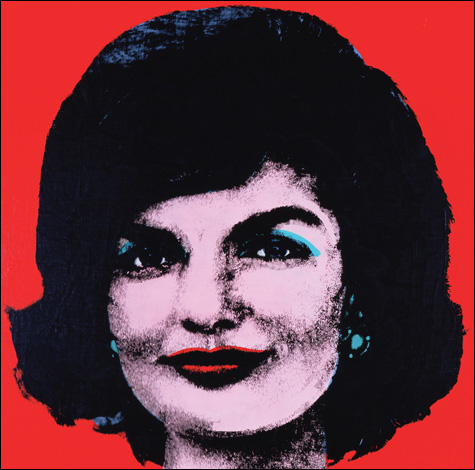
NO KIDDING: In Warhol's Jackie, we witness her transformation from sunny, smiling first lady to
shattered widow. |
“Andy Warhol: Pop Politics” | Currier Museum Of Art, 150 Ash St, Manchester, New Hampshire | Through January 4
“Invisible Rays: The Surrealist Legacy” | “Project For A New American Century” | Rose Art Museum, Brandeis University, 415 South St, Waltham | Through December 14 |
For a while now I've been mulling over a question: was Andy Warhol more politically engaged than he's given credit for? My thought begins with his 1963 Race Riot screenprints based on Life photos of police siccing German shepherds on civil-rights demonstrators in Birmingham, Alabama. The subject of civil rights rarely appears in books documenting '60s art. Could Warhol's taking it on be significant?"It just caught my eye," he said of Race Riots in 1966. Two years later, he added, "I feel I represent the US in my art, but I'm not a social critic. I just paint those objects in my paintings because those are the things I know best."
Of course, Warhol was notoriously and deliberately flaky in interviews, so we write off much that he said and look for clues in his work. The consensus verdict: his art is about media, celebrity, and the nature of art. The corollary: he focused on electric chairs, atomic mushroom clouds, Chinese dictator Mao Zedong, and Communist hammers and sickles because they were in the news at the time — he was just channeling the zeitgeist. But could he have been engaged in the political substance of his images?
Of all those works, the Currier Museum of Art's "Andy Warhol: Pop Politics" has only Mao. On the other hand, you'll see Warhol's most outright political statement: a 1972 poster of a green-faced Richard Nixon above the slogan "Vote McGovern" that he made to raise money for the McGovern campaign. Later he backed off, claiming, "The idea was that you could vote either way." He didn't want to offend potential clients — and the portrait business is the show's focus, not politics. I still recommend "Pop Politics" for what it is: a fizzy survey of Warhol's effort to become a modern-day court painter.
It opens with Jackie (circa 1964), six screenprints based on news photos of Jackie Kennedy, from her arrival in Dallas with her husband to her mourning after JFK was shot dead there. It's the most emotionally moving work Warhol ever did. We witness Jackie's wrenching transformation from sunny smiling first lady to shattered widow. Warhol emphasizes this by cropping the grainy photos down to just her head and shoulders. The photos, emerging from mourning veils of blue or silver, seem to flicker next to one another, like flashes from TV or memory. We empathize with this woman, the depth of whose mourning we can't fathom, but whose grief represents our own, and the nation's.
Warhol returns to JFK's assassination five years later with Flash — November 22, 1963, a portfolio of 11 technicolor prints of a smiling (black on black) JFK, the president and his wife in the motorcade, Lee Harvey Oswald, and the Texas School Book Depository, from where Oswald is deemed to have fired the fatal shots.
