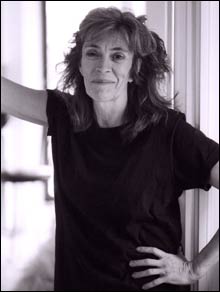
 Anyone who’s listened to a homesick Texan sing the high lonesome song of longing for the Lone Star State will recognize the tune of Gail Caldwell’s memoir, A Strong West Wind. It’s all there: the landscape engraved by ferocious elements, whittled by wind and water, the barrenness of the vista stretching to the horizon. And, of course, the relentless wind. Caldwell gives it a voice, reminding us that it once tore across the Panhandle, turning the high plains into a desert. She’s internalized the geography of Texas, and the memory of the land is her touchstone.
The book moves from the wide-open grasslands to small-town life in Amarillo, where she grew up, circa the late 1950s, not much more than a way station on Route 66. “A shy girl in glasses in a do-nothing town,” the bookish young Caldwell took refuge from provincial boredom in the library. It’s here she finds her “true north”: literature becomes the mechanism by which she will process her life. Caldwell has spent the last two decades as a book critic for the BostonGlobe, and in 2001 she won the Pulitzer Prize for Distinguished Criticism, so she obviously knew how to read her compass.

Books become the frame through which she revisits her life, and every event has a literary precedent. She worships her father, a kind of Scout to his Atticus Finch, until teenage rebellion disrupts the bond. She takes Thomas Wolfe and William Faulkner as her allies when conflicted feelings toward the South spur her guilty decision to escape it. She feels her heart “clenched in recognition” when she reads Absalom, Absalom. Her obsession with war novels, in a time of relative peace, foreshadows the event that will truly activate her, Vietnam.
Much of the memoir describes how it felt to be an American girl waking from a safe, suburban delusion to a revolution — what it meant to come of age in the ’60s. “Whether your trouble was a drug problem or tear gas in the face, you could attribute some of it to the times in which we lived.” She recalls the surreal incongruity of television in those days, when footage of body bags unloaded from military planes “like auto parts from the line in Detroit” ran cheek by jowl with Father Knows Best and Captain Kangaroo. She moves from war resister to dedicated feminist. But there remains something ambivalent about her activism.
This is a frustrating element of Caldwell’s memoir: she bares her soul but skimps on the gritty detail. Her descriptions of early rebellion, replete with sex, drugs, rock and roll, and a hippie pilgrimage to California in the summer of ’71, seem strangely tidy. It’s as if that keening wind that blows through her prologue had scoured her narrative smooth and sanitized her experiences.
When her elegiac prose focuses on specifics, like her relationship with her father as he moves from her ideal to her adversary and back again, she’s at her best. At other times, she resorts to sweeping Texas-sized generalizations rather than doing the uncomfortable and sometimes dirty work of explication. She becomes an onlooker rather than a witness, suddenly pulling back to become the voice of her generation. “We’d traded down Walden for Woodstock Nation, tragedy for the melodrama of Easy Rider. The long arc of history seemed remote and irrelevant, and we jettisoned intellectual cornerstones as capriciously as we shed bourgeois fashion.” We want the words of the woman on the ground and instead we get aerial footage.
Gail Caldwell | March 31, 7 pm | Porter Square Books, Porter Square Shopping Center, 25 White St, Cambridge | 617.491.2220
