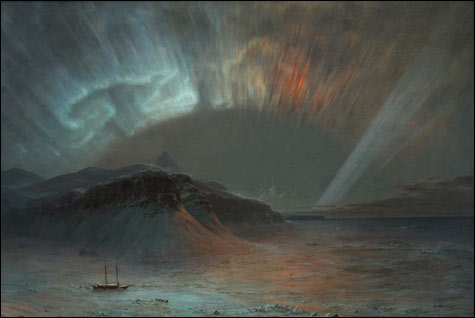
AURORA BOREALIS: Frederick Edwin Church’s seven-foot-wide painting is just one of the showstoppers at the Peabody Essex. |
“To the Ends of the Earth” | Peabody Essex Museum, East India Square, Salem | Through March 1 “Mythic Creatures” | Museum of Science, 1 Science Park, Boston | Through March 22 |
In July 1860, Captain Isaac Israel Hayes's schooner, the United States, left Boston and sailed to the Arctic. He was in search of the legendary open polar sea, a hoped-for water passage to the North Pole or between Europe and the Pacific. But it was also the kind of voyage one made in order to test oneself against Earth's final forbidding untamed frontier.By October, the ship was frozen in, and the men continued north by dogsled. When conditions finally stymied Hayes's progress, he scaled an icy hill and scanned the horizon.
Recounting his experiences of May 1861 in his book The Open Polar Sea, Hayes wrote, "All the evidences showed that I stood upon the shores of the Polar Basin, and that the broad [frozen] ocean lay at my feet . . . and within a month, the whole sea would be as free from ice as I had seen the northern water of Baffin Bay." He added, "I have shown that the open sea exists." He turned out to be wrong, but it was a thrilling tale.
Hayes named one of the icy mountains Church Peak, after his artist friend Frederick Edwin Church, who had given him some drawing lessons. And he gave Church his sketch of it after sailing back into Boston Harbor in October 1861. Drawing on Hayes's tales and that chalk drawing and his own experience sketching icebergs on Newfoundland and Labrador in 1859 and the aurora borealis on Mount Desert Island in Maine in 1860, Church invented an astonishing seven-foot-wide canvas, Aurora Borealis (1865).
The painting is one of the showstoppers of the excellent exhibit "To the Ends of the Earth: Painting the Polar Landscape" at Salem's Peabody Essex Museum. The sky glows with green and red ribbons, like the contrails of dragons. Below, Hayes's tiny schooner lays trapped in a world of ice. A speck of a man dogsleds toward the warm orange glow of the ship's cabin window. It's an eerie scene that echoes Hayes's description of the Northern Lights: "Upon the mountain tops, along the white surface of the frozen waters, upon the lofty cliffs, the light glowed and grew dim and glowed again, as if the air was filled with charnel meteors, pulsating with wild inconstancy over some vast illimitable city of the dead."
Organized by Peabody Essex curator Sam Scott, "To the Ends of the Earth" features more than 50 landscapes and seascapes from the "heroic era of polar exploration." Many of the Peabody Essex's recent marquee exhibits have been distinguished as much by the showmanship of the displays as by the art. This is a straightforward, few-frills, traditional painting and drawing show. And the work holds its own. What unites the art is the elemental drama of light — sun and moon and aurora borealis — playing over icy forms.
The exhibit ranges from a 1779 sketch of Captain James Cook's ships navigating an icy Bering Strait (inked by a member of Cook's crew) to late-19th-century Hudson River School adventure spectacles (like Church's canvas) to Modernist landscapes from the 1930s. They are realist (if sometimes pared down) illustrations, often based on direct experience, of epic adventures (real and imagined) by white guys confronting the earth's limits. One Antarctic landscape here was painted by a stranded member of Ernest Shackleton's ill-fated 1914 Endurance expedition as he awaited rescue. Audiences back home drank up such otherworldly tales — much the way we favor Hollywood action blockbusters or tune in to Deadliest Catch.
Massachusetts native William Bradford voyaged to the Arctic several times in the 1860s and made his name with his icy scenes. His 10-foot-wide canvas Sealers Crushed by Icebergs (1866), which sweeps you up in its scale and drama, is the exhibit's bookend to Aurora Borealis. In the foreground, men transfer gear, crates, and barrels into rowboats as they flee their crunched ship. In the distance, men drag a boat across the ice and a ship burns. On the horizon, tiny ships lie crooked and stuck. In the middle of it all rises a jagged, unyielding icy peak, gleaming blue and green in the sun's spotlight.
In the 1930s, David Abbey Paige's pastels accurately recorded unbelievable halo'd moons, flaring suns, and blood-red clouds. But the 20th-century work here mostly shows the streamlining impulse of early Modernism. Rockwell Kent simplified and flattened the snowy peaks and icy blue waters of Alaska and Greenland into romantic scenes that could double as travel posters. Lawren Harris turned icebergs into strangely mechanical towers in a style that suggests Marsden Hartley or Arthur Dove. These paintings were the last hurrah for avant-garde Arctic art (until our current time) as the tradition of on-the-spot observation was supplanted by abstraction around mid century.
