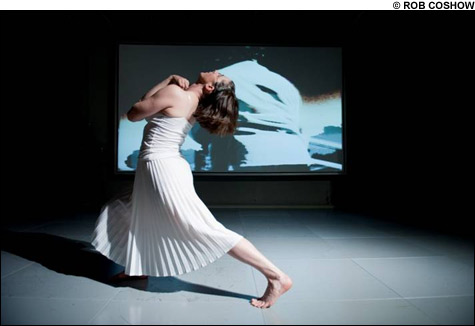
LOOPING: Marjorie Morgan told a story about seashore memories against Jed Speare's video of the tide coming in over a rocky shore, raindrops, a windshield wiper — cycles that recycled through the dance. |
Dance has a built-in affinity with computer technology. Both are mobile, ephemeral, time-based media that can generate ideas faster than the mind can articulate, organize data in unlimited ways, and forget as easily as they can remember. Merce Cunningham has used computers as co-creators for his choreography since 1991, and it was his evolving dance Loops that inspired the six works shown Friday night at the MIT Museum to open the sixth Boston Cyberarts Festival.
Loops, a solo Cunningham started performing in 1971, is really a choreographic scheme rather than a set choreography. Cunningham adapted it to whatever performing situation and physical state he found himself in at the moment. It always started with a squiggle of the wrist that would spread through his body, and as his movement looped and plunged, he'd seem to be following all kinds of interesting things that were taking place around his body.
When age and arthritis shrank his workable kinesphere, Loops continued as a dance for his hands and fingers. In 2000, Paul Kaiser, Shelly Eshkar, and Marc Downie filmed it in motion capture. Eshkar and Kaiser had written the motion-capture protocols for Cunningham's stunning dance BIPED (1999) and Bill T. Jones's Ghostcatching. Their idea for Loops was to create a new artwork, but the software was subsequently released so that it could be used by other artists. (Readers can start exploring this arcane and fascinating resource at www.bostoncyberarts.org/loops.)
The result on view at the MIT Museum comprised three abstractions made from the motion-captured Loops and a digitally enhanced video of Cunningham's face in the original recording. Call them objects, artworks, installations — I'm not sure the nomenclature has caught up with the technology. You can't absorb these works as if they were fixed objects in an art gallery; like dances, they happen over time. In some cases they reconfigure the same information endlessly, so there's no finished artifact.
In the video, Merce in Motion, designer Brian Knep focused on Cunningham's face in close-up, so that it's possible to detect micro-emotions underneath the deliberately neutral expression the choreographer maintains as he performs the dance.
Loops translates into a "visually minimal diagram" in the piece by designer C.E.B. Reas called Merce: two quivering, opposing shapes resembling sails, based on the information Reas captured from one of Cunningham's dancing hands. For Golan Levin, the moving fingers and knuckle joints produced a blobby animated creature in Merce's Isosurface.
Ascenders & Descenders, by Sosolimited (Eric Gunther, Justin Manor, and John Rothenberg), offered intellectual challenge as well as visual pleasure. Words are inadequate to explain or simulate a dance, as Cunningham has pointed out — though he's contributed a few chapters himself to the cause. Sosolimited amiably appropriates 10 writers' "feeble words that huff and puff to make sense of Merce's work" and converts them into overlapping strings that move in spritely swirls and clumps according to the data from Cunningham's motion-captured fingers.
Graphically altered, like the original dance itself, the quotes take on a new identity. They also raise the kind of questions about originality and ownership that are affecting all writers and artists in the digital age.
