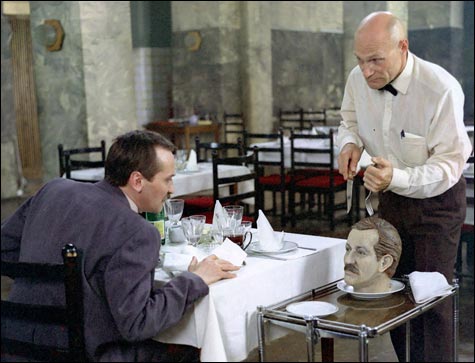
ZERO CITY: If Buñuel had done time in a Communist country, this might well have been the result. |
| “The Films Of Karen Shakhnazarov” | Museum of Fine Arts | December 3-6 |
We take Russian films as we can find them these days, one at a time, whether they be the sand-blasting pulp epics of Timur Bekmambetov, the brooding melodramas of Andrei Zvyagintsev, or the annual beautiful but often frustrating offering by master enigmatist Aleksandr Sokurov. Vodkal driblets of psychotronica and metaphor and dreaminess, respectively, but no "Russian cinema" per se. Given the nation's current state of being — tugged into irritation by a corrupt and overbearing government, run in actuality by trade "oligarchs," and permanently confused about its renascent nationalism and new economic growth — one could hardly expect anything like a cohesive film culture, especially since the once-mighty state-supported industry has had to rebound from its post-Soviet crisis by way of private funds and scraps of government funding.Significant figures do loom, though mostly out of our stateside view — Aleksei German Sr. and Jr. are both making vital and extraordinary films, though nothing of their work has been released here. The same goes for famed cinema-of-cruelty doyenne Kira Muratova, who at 72 released her 18th film last year. A less ostentatious, and far more audience-friendly, Russian film mill is Karen Shakhnazarov, whose career stretches back to the '70s but who only now, in the Putin years, is being recognized as one of Russia's signature voices.
Perhaps his makeover began with ZERO CITY (1988; December 6 at 1:30 pm), something of a perestroika landmark that also stands in sharp relief to his usual thematic terrain. It's an absurdist, Kafka-esque comedy-without-laughs in which a Moscow engineer (Leonid Filatov) arrives in a small town to modify a tiny air-conditioner part, cannot get a straight answer, is met with all manner of surreal non-sequiturs (a naked secretary, a restaurant cake in the shape of the hero's head, a bolero of hyper-paranoid suspicions), and in the end realizes he can never leave. If Buñuel had done time in a Communist country amid his many exiles, this might well have been the result. But it also makes you wonder how any such scenario could ever have found textual roots without the enriching benefit of a psychotic totalitarian bureaucracy — or perhaps how such a social context adds ferocious weight and size to any symbolic narrative idea. Whatever: Zero City is a low-key, deliberately methodical walk through the subconscious life of the Soviet quotidian, and having watched it you walk away with a genuine sense of a cultural reality.
 Related
:
Movies from outer space, K is for clown, Marx in Somerville, More 
- Movies from outer space
Our new-found DVD-ness and cable-TV luxury notwithstanding, movies have always been a public medium, a spatial experience we share in the theater and a topical experience we share in the culture at large.
- K is for clown
The lighter side of global annihilation
- Marx in Somerville
Howard Zinn meets Jimmy Tingle Who would brave Arctic weather to watch Karl Marx pontificate?
- Review: Absurdistan
Delicatessen sort of meets Borat in Veit Helmer's visually ripe, magic-realism-lite tale of life in a mythical Eastern European country that time forgot after the dissolution of the Soviet Bloc.
- Kino pravda
Because Mosfilm, the subject of the Museum of Fine Arts’ “Envisioning Russia” retrospective, was the Soviet state production studio, any cross-section of its history lays out the entirety of Soviet film history.
- Latter day taint
Fifteen years ago, Glenn Beck was a small-market DJ with a drinking problem, no friends, and bleak professional prospects. Today, he’s a Fox News superstar averaging 2.4 million viewers, an inexorably successful author, and the leader of a popular movement that condemns government in general and President Barack Obama in particular.
- A Thousand Years of Good Prayers
The relationship between fathers and daughters is complicated enough without being further strained by Mao’s Cultural Revolution.
- Flashbacks: June 9, 2006
These selections, culled from our back files, were compiled by Chris Brook and Sam MacLaughlin.
- Georgia on your mind?
So much for the Republican Party’s long-standing boast that Ronald Reagan neutered the Soviet Union.
- Khrushchev calls conflict a matter of protecting Russians
At press time, Russian President Dmitry edvedev declared a halt of military operations against the former Soviet republic of Georgia.
- Cuba si, Cuban cinema no
This article originally appeared in the September 28, 1976 issue of the Boston Phoenix.
- Less

Topics:
Features
, Communism, Museum of Fine Arts, Bolshevik Party, More
, Communism, Museum of Fine Arts, Bolshevik Party, Malcolm McDowell, Timur Bekmambetov, Gillo Pontecorvo, Alexander Sokurov, Karen Shakhnazarov, Karen Shakhnazarov, Kira Muratova, Less
