The HFA looks back at the bad boy of Japanese cinema
By BRETT MICHEL | December 5, 2008
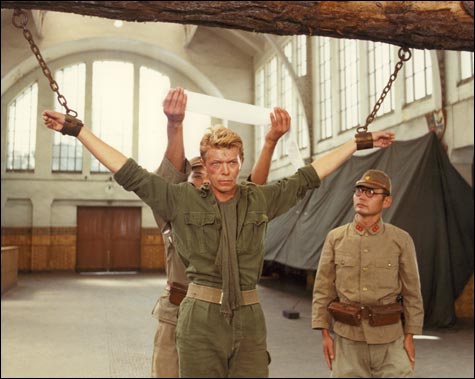
MERRY CHRISTMAS MR. LAWRENCE: Treading lightly on the homoerotic tensions in a POW camp. |
| “Nagisa Oshima and the Struggle for a Radical Cinema” | Harvard Film Archive: December 7-22 |
Credited as one of the originators of the Japanese "New Wave" alongside Masahiro Shinoda, Kiju Yoshida, and the late Shohei Imamura, director Nagisa Oshima (born 1932) — who's being celebrated at the Harvard Film Archive this month — is among the generation that came of age during wartime and its uncertain aftermath. Working under the aegis of iron-fisted Shochiku Studio head Shiro Kido, Oshima and his contemporaries rejected the slick, Hollywood-inspired productions that Shochiku had been known for turning out month after month in favor of nihilistic films featuring the generation of sex-crazed, violent adolescents known as the "taiyozoku," or the "Sun Tribe."This new genre came of age (and gained its moniker) in 1954 when rival studio Nikkatsu released Takumi Furukawa's Season of the Sun, which was based on Shintaro Ishihara's award-winning novel about youths gone wild. But it was Ko Nakahira's immensely popular tale of depraved delinquents, Crazed Fruit, which Nikkatsu released two years later, that opened Oshima's eyes to a new generation of Japanese film and paved the way for his landmark CRUEL STORY OF YOUTH (1960; December 8 at 7 pm). This widescreen Technicolor shocker was unprecedented in its toxic depiction of sex, violence, and anti-American sentiment. Shot in a free-form, unpolished style with hand-held cameras, it recalls the classic that helped launch the French New Wave, Jean-Luc Godard's Breathless, which was released the same year.
The critical and commercial success that greeted both Cruel Story of Youth and his subsequent taiyozoku-themed picture, THE SUN'S BURIAL (1960; December 8 at 9 pm), were a vindication of Oshima, whose first film for Shochiku, A TOWN OF LOVE AND HOPE (1959; December 7 at 9 pm), received only limited distribution. Kido hated the end result, though perhaps not as much as he disliked Oshima's preferred title: The Boy Who Sold His Pigeon. The story of a thieving schoolboy whose scheme involves selling a homing pigeon that he's trained to return home shortly after he gets paid takes place in a town that offers him neither love nor hope. Still, the film elicited positive reviews.
Tensions with Kido came to a head upon the release of Oshima's fourth film, NIGHT AND FOG IN JAPAN (1960; December 12 at 7 pm), a political essay (and homage to Alain Resnais) that rails against both the right and the left and their inability to forestall the inevitable renewal of the controversial US-Japan Security Pact. Although the 43 highly theatrical extended shots that constitute the film would make Resnais (and even Godard) proud, Kido, who hadn't been aware of the film's secretive shoot, took great offense at the picture's radical political content, pulling the movie from theaters after just three days in limited release.
 Related
:
Review: Petition, Camera obscura, Naked truth, More 
- Review: Petition
This distressing documentary explores a netherworld of individuals who have come to Beijing from all over China hoping that their grievances against their local governments will be heard.
- Camera obscura
An acquired taste in French cinema, Philippe Grandrieux is an abstractionist who does narrative features, a post-punk artiste as comfortable making Marilyn Manson music videos as he is war-zone documentaries. But his three major features — which the Harvard Film Archive is screening this weekend and next — revel in a dangerous minimalism.
- Naked truth
The George Kuchar renaissance that began with the release of Jennifer M. Kroot's affectionate documentary detailing "the 8mm Mozarts," George and his twin brother Mike, builds to a climax this weekend when the Harvard Film Archive welcomes George.
- Moral support
For Jean-Louis, the dour engineer played by Jean-Louis Trintignant in My Night at Maud's , one of 10 superb miniatures screening in the Harvard Film Archive's series "The Human Comedies of Eric Rohmer," every woman with whom he has an affair poses a moral challenge.
- Pier Paolo Pasolini at the Harvard Film Archive
Perverse, graphic, and despairing, Pasolini's films are some of the most humane in cinema.
- Burden of dreams
As the title of Siegfried Kracauer's landmark book From Caligari to Hitler puts it, the politically shaky, culturally fertile Weimar Republic lasted roughly from Robert Wiene's nightmarish Expressionist allegory The Cabinet of Dr. Caligari (1920) to the establishment of the all too real Third Reich in 1933.
- Review: Die Nibelungen
Fritz Lang's other classic
- The laid-back intricacies of Hong Sangsoo at the HFA
"Your sincerity needs its own form," a film professor advises a student in prolific Korean director Hong Sangsoo's most recent work, OKI'S MOVIE. "Form will take you to the truth. Telling it like it is won't get you there."
- Buñuel continues to delight, confound, and shock
Openly, contentedly delighted with how our own dreams can appall us, and how close movies are to that appalling dreaminess, Luis Buñuel — the subject of an extensive survey at the HFA this month — may have been the greatest filmmaker of the medium's first century.
- Premiere: Two Years At Sea
London-based filmmaker Ben Rivers has proven a restless creator.
- Days of future past
Science-fiction films have been with us since Edison’s 1910 version of Frankenstein , but they bloomed in the ’Nam era, nourished by a volatile cocktail of cultural ingredients.
- Less

Topics:
Features
, Entertainment, Music, Pop and Rock Music, More
, Entertainment, Music, Pop and Rock Music, Movies, Punk Rock, Jean-Luc Godard, Alain Resnais, Shohei Imamura, Shohei Imamura, Yasujiro Ozu, Less
