The Phoenix Network:


About  |  Advertise
 
CD Reviews  |  Classical  |  Download  |  Live Reviews  |  Music Features  |  New England Music News

Isn’t it rich?

Sondheim and Follies , the BSO’s French evening, and Boston Baroque’s Xerxes
By LLOYD SCHWARTZ  |  November 3, 2008

081031_follies_main
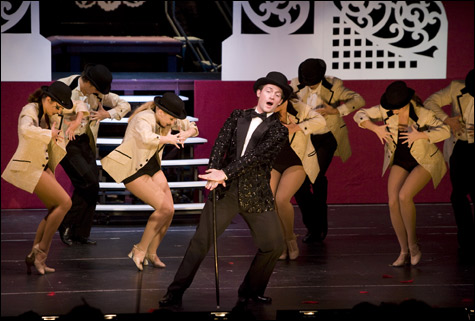
FOLLIES: Sondheim, it seems, doesn’t approve of student productions of this work — too bad he didn’t see this one.

The biggest musical celebrity in town last week was Broadway great Stephen Sondheim, who filled Northeastern University’s Blackman Hall “in conversation” with his long-time associate, producer/composer Sean Patrick Flahaven. For 90 minutes they covered the more than half-century span of Sondheim’s career (he’s now 78), from the early Saturday Night through the forthcoming revival/revision Road Show. “I like writing about obsession,” Sondheim said. “It lends itself to passion.” Flahaven asked why so many of his musicals were about marriage even though the composer has never been married. Sondheim said that the qualities Shaw recommended for a playwright were experience, observation, and imagination, but that you could still get by with only two of these. When he was working on Company, he said he interviewed his friend Mary Rodgers (Richard Rodgers’s daughter), who had recently remarried. “This may sound crass,” he admitted, “but I took notes.” When he was finally in a relationship, this most private of artists added, he could then write about this subject from the inside.

He praised Du Bose Heyward’s lyrics to Porgy and Bess’s “Summertime.” “I would have written ‘Summertime, when the livin’ is easy.’ It takes a genius to write ‘Summertime, and the livin’ is easy.’ ” Asked about the scarcity of rhyme in his 1994 musical Passion, he said that rhyme “bespeaks control — a certain amount of reserve, of intellect” that wouldn’t be appropriate for these romantic characters. Responding to the accusation that he writes tunes you can’t leave the theater humming, he said, “If you hear any music enough times, you can hum it. I can hum the Berg Violin Concerto.” Why hadn’t he written much since Passion? “The older I get, the more frightened I get of writing. A new subject has to scare you because you’ve never done it before.” About his use of irony: “I’m a traditionalist — I believe in content dictating style.” Asked by a young composer in the audience whether he regarded his music as a profession or a calling, he said, “It’s a privilege to write music. It’s more than a profession — it’s a pleasure.” He was hoping, he said, to write another “large romantic piece like Sweeney Todd — something pretentious.”

On a TV documentary, Sondheim once introduced a “medley of my greatest hits: ‘Send In the Clowns.’ ” At Northeastern, the conversation was punctuated by pianist Charlie Alterman accompanying the radiant Kate Baldwin (she was the touching heroine of the Huntington’s She Loves Me) in a revelatory series of less familiar Sondheim songs that included the exquisite “I Remember Snow” (from his TV musical, the creepy Evening Primrose), “The Miller’s Son (a self-knowing celebration of sexuality and fantasy, from A Little Night Music), “Another Hundred People” (an ironic paean to New York, from Company), and the heartbreaking “Loving You,” from Passion.

This has been a good period for Boston’s Sondheim fans. This fall, there’ve been two terrific productions of Follies, perhaps his most ambitious show (in which “real life” becomes transformed into a series of production numbers): one at Lyric Stage, with a cast of Boston favorites, and one at Boston Conservatory, with a stageful of its staggeringly gifted students, the latest incarnation of its love affair with Sondheim, and director Neil Donohoe heading the brilliant production team. Sondheim, I gather, doesn’t approve of student productions of this show, which is so much about the immaturity of maturity. Too bad he didn’t see Lauren Lukacek, as the naive, self-deluded Sally, and Hannah Jane McMurray (the next Donna Murphy?), as the painfully all-too-knowing Phyllis — very adult performances by actresses who can also sing and (especially McMurray) dance. This was, as always, a team effort, and the curtain call consisted of individual bows for each member of the huge, deserving cast.

An appallingly overamplified sound system distorted both speaking and singing voices to the point of incomprehensibility. Some amplification may be necessary because the theater has no orchestra pit. But opening night, when one performer’s body mic gave out, he could actually be heard more distinctly and appealingly. The school has started a fund drive for a new theater complex (with an orchestra pit!); the best theater department in town deserves a more up-to-date venue.

Boston Conservatory’s String Masters Series presented the estimable Jorja Fleezanus — who’s about to retire from the Minnesota Symphony, where she’s been concertmaster for the last 20 years — in a delicious chamber recital with her frequent partner, master accompanist Karl Paulnack. Spirited and sensitive playing were the order of the evening in a varied program that began with Bach’s E-major Sonata (Fleezanus called it “a honey of a piece”) but centered on two 20th-century pieces, Yehudi Wyner’s rich, rhapsodic, ferocious, jazzy, no-holds-barred Concert Duo (50 years old, but not a bar has dated) and George Perle’s antic, nose-thumbing neo-classical Triptych.

1  |  2  |   next >
Related:
  Topics: Classical , Stephen Sondheim , Stephen Sondheim , Pierre Boulez ,  More more >
  • Share:
  • RSS feed Rss
  • Email this article to a friend Email
  • Print this article Print
Comments

Today's Event Picks
ARTICLES BY LLOYD SCHWARTZ
Share this entry with Delicious
  •   LIFT EVERY VOICE!  |  December 30, 2008
    Classical goodies for 2009
  •   YEAR IN CLASSICAL: CELEBRATE!  |  December 22, 2008
    Comings and goings
  •   PHENOMENAL!  |  December 19, 2008
    Elliott Carter turns 100
  •   A SONG TO SING, O!  |  December 02, 2008
    Seiji Ozawa returns to the BSO, Boston Early Music Festival's 17th-century chamber operas, the Bostonians' Yeomen of the Guard
  •   OVER (AND UNDER) THE TOP  |  November 24, 2008
    Musical chairs at the BSO, the Pacifica at Longy, the Boston Philharmonic's three B's, and the Cecilia's Bach B-minor Mass

 See all articles by: LLOYD SCHWARTZ

MOST POPULAR
RSS Feed of for the most popular articles
 Most Viewed   Most Emailed 


Friday, January 09, 2009  |  Sign In  |  Register
 
thePhoenix.com:
Phoenix Media/Communications Group:
TODAY'S FEATURED ADVERTISERS
Copyright © 2009 The Phoenix Media/Communications Group