The Phoenix Network:
 
 
About  |  Advertise
Adult  |  Moonsigns  |  Band Guide  |  Blogs  |  In Pictures
 
Media -- Dont Quote Me  |  News Features  |  Talking Politics  |  This Just In

Rolled

Where’s the outrage over media mistreatment at the RNC?
By ADAM REILLY  |  October 2, 2008

081003_rolled_main
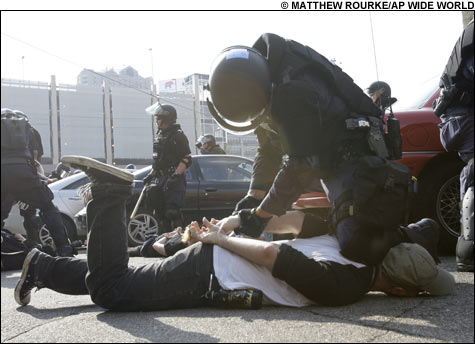
‘WELL-CONNECTED’: After taking the photo above, of a conflict between law enforcement and RNC protesters, Associated Press photographer Matt Rourke was himself tackled and bloodied by police. He was arrested and held for 10 hours, then released without being charged. 

• Among the Republican thugs: Fear and pepper spray in St. Paul. By Anne Elizabeth Moore.

• Photos: Republican National Convention 2008. 

Given the media’s reputation for self-absorption, it’s remarkable how little attention the press has paid to the crackdown on journalists during September’s Republican National Convention. While the exact tally varies from source to source, it seems that close to 50 journalists were detained or arrested in St. Paul (out of approximately 800 arrests total) while covering protests outside the convention. Some of them were treated gently and released quickly, but others were held at length or roughed up by the police. What’s more, a pre-convention raid on a St. Paul home targeted members of I-Witness Video, a New York group whose work exonerated hundreds of protesters following the 2004 RNC. And while St. Paul city attorney John Choi announced, on September 19, that many cases against journalists wouldn’t be pursued — in particular, those involving the possible misdemeanor count of presence at an unlawful assembly — these decisions are being made on a case-by-case basis and are far from complete. 

Oddly, though, the jeopardy that journalists faced in St. Paul never became much of a story. There wasn’t a news blackout, exactly: the Associated Press (AP) and the local Minnesota media covered the issue, as did left-leaning outlets like the Nation and Salon, and national heavyweights like ABC News and the Washington Post gave it some early, blog-based coverage.

The problem, instead, is that the story was ignored or minimized by other important organizations — the New York Times being the most prominent example — and, as the weeks progressed, never seemed to generate any sort of sustained concern inside the media itself, the efforts of groups like the Society for Professional Journalists notwithstanding. In the words of Mark Jurkowitz, associate director of the Pew Research Center’s Project for Excellence in Journalism, “It never really got into the conversation at a level where it had an impact.”

What’s especially strange about this is that the activity that got these journalists into trouble — monitoring the exercise of government power — is one of the most important things the fourth estate does. So why the muted response to their plight?

A bridge, too far?
One answer, obviously, is that it’s been kind of a busy month. Think of the other stories that have been kicking around since the first journalists were arrested on September 1, the RNC’s opening day: Hurricane Gustav, Sarah Palin’s debut, McCain’s acceptance speech and post-convention bump, the sequestering of Palin, her subsequent public implosion, the Wall Street meltdown, McCain’s one-day suspension of his campaign, the first presidential debate, Obama regaining front-runner status. Oh yeah, and Hurricane Ike.

1  |  2  |  3  |  4  |   next >
Related: Among the Republican thugs, Judge dismisses RNC protest case, Wacko patrol: America's 25 scariest conservatives, More more >
  Topics: Media -- Dont Quote Me , Barack Obama, John Choi, Politics,  More more >
  • Share:
  • Share this entry with Facebook
  • Share this entry with Digg
  • Share this entry with Delicious
  • RSS feed
  • Email this article to a friend
  • Print this article
Comments
Re: Rolled
Most of what you say is spot-on, as far as it goes. But why should we journalists have more rights than the people who were demonstrating. As in New York four years ago, so, it appears, in St. Paul: scores of people were arrested, and some roughed up in the process, for exercising their constitutional rights. In New York, the police were found to have lied in arrest reports and affidavits. And the authorities have admitted that they infiltrated anti-war organizations--as if being against the war and wanting to say so publicly is somehow dangerous and unlawful.So, yes, we should be outraged that reporters have been such timid watchdogs. But we should also be outraged at the larger issue: that speaking out has been turned into a criminal offense.
By squattercity on 10/02/2008 at 1:29:01
Photographers' rights and th erosion freedom of the press - WHERE'S THE OUTRAGE
It's terrible what's happening to freedom of the press - and the press is too embarrassed, scared, busy or naive  to make it an issue. But these civil rights abuses are occurring with alarming frequency. Carlos Miller at http://photographyisnotacrime.org  is tracking them. This is something that affects more than just journalists as nearly everybody has a digital camera on their hip or in their phone. Many do take photos of police - and for that act they are often charged with resisting arrest (same charge as most of the journalist at the RNC and DNC). Before these police transgressions were brushed aside as it was he said/she said and police authority almost always won - today these abuses are documented. We need the journalists to use their bully pulipit, while they still have one, to stand up for themselves and their fellow watchdogs - the millions of Americans with no axe to grind but who carry a camera, or a video camera.  
By enhager on 10/02/2008 at 3:02:56
Re: Rolled
Thanks for your comment, SC. My point is that journalists need to protect our constitutional rights and customary privileges so we can keep documenting the use and abuse of government power--which, as I say in the piece, is the most important thing we do.I don't want to see anyone's First Amendment rights violated. But if that *does* happen, I want to make sure that reporters and photographers are there to catch it and fill me in. It's a tricky dynamic: our legal rights are the same as the general public's, but our social role is different. And in the end, the best way for us to guard the public's rights is to make sure we can keep doing our jobs.
By Adam Reilly on 10/02/2008 at 3:39:15
Re: Rolled
Tried responding before, SC, but I'm not sure it worked, so here's a short reply: the public is only going to know about government misbehavior if journalists can tell them. That's why I want the press to jealously safeguard both its constitutional rights (which, when it comes to newsgathering, are the same as the general public's First Amendment rights) and any customary privileges (e.g., quick release for journalists caught up in law-enforcement sweeps). 
By Adam Reilly on 10/02/2008 at 3:57:38
Re: Rolled
Sorry for not reading your article Adam, but the photo and caption said it all.
By gordon marshall on 10/03/2008 at 1:23:24
Re: Rolled
I've wondered about this 'same' question myself, "Why so little media coverage of the harassment and bully arrests of journalists at the Republican Convention?".  Makes you wonder.  It's not safe to speak out against the right-wing.  And you think facism doesn't exist in this country?  Think again.
By Chelsea Hoffman on 10/03/2008 at 11:49:17
Re: Rolled
This is patently absurd and America has become a police state:From Chris King's 1st Amendment page:
Adam Reilly’s sidebar "Rolled," quotes Reporter’s Committee for Freedom of the Press’ (RCFP’s) Lucy Dalglish as saying that Goodman “went too far,” but in reality all she did was ask a cop about her arrested reporters, who too were probably arrested without Just Cause. She had full press credentials, of course.

Again, watch the video closely: The cop lets her walk past him initially so she has no idea that she is subject to arrest. Then she stands back from him with her hand up in a defensive position and tries to ask him a simple question. It takes him all of 4 seconds to put his hands on her and he never lets go, even as she is explaining her credentials and that she is simply trying to find her staff. Then without ever letting go of her even as they are heading toward the “safe zone” he sua sponte drags her back the other direction and arrests her. She is not forcibly resisting him at all. At. All.

Implicit in Dalglish’s statement is the notion that you are supposed to get ready to be arrested for politely asking a police officer “what’s up?” It’s absurd. A buddy of mine in Ohio resisted an Unlawful Arrest and told a cop to go to hell and that he was a real *ssh*le and that is protected speech. See State v. Sansalone, 71 Ohio App. 3d 284 (1991). And what else do I know about wrongful arrest? I helped my boss, Terry Gilbert, author the successful flag burner appeal in State v. Lessin, 67 Ohio State 3d 487 (1993) and got two cops in Hamilton, Ohio adjudicated as making Michael Isreal a victim of violent crime (V1996-61481), won his criminal case before an all-white jury and settled his civil case for $58,500.00 even though he had no visible injuries. Unlike Michael Paulhus in Nashua, NH who got shot and still only got $80K.
By KingCast on 10/04/2008 at 6:42:15
Re: Rolled
Read my comment on this matter over at the Main story, but my point is, chiefly, that Amy Goodman didn't deserve to be arrested. I have litigated these types of issues and watched the video closely, and what happened is patently absurd, as I noted yesterday at Chris King's 1st Amendment Page. This is but one example of America's Police State. 
By KingCast on 10/04/2008 at 7:13:48
Re: Rolled
Seems to me the media is in bed with the gov't is in bed with big business. Can the remaining honest reporters do anything about it, or do we need to send a message via the Batsignal?
By CazmoP on 10/07/2008 at 6:54:44

ARTICLES BY ADAM REILLY
Share this entry with Delicious
  •   HOLY TERROR?  |  November 16, 2009
    On the afternoon of November 5, Army Major Nidal Malik Hasan walked into a building at Fort Hood, the sprawling military base in central Texas; sat briefly in solitary silence; and then opened fire with a semi-automatic pistol, shooting roughly a hundred rounds and killing 12 soldiers and one civilian.
  •   DIFFERENCE OF OPINION  |  November 09, 2009
    It’s been three months since Peter Canellos replaced Renée Loth as editor of the Boston Globe ’s editorial page.
  •   THE IMPORTANCE OF BEING ERNIE  |  October 19, 2009
    Media feuds don’t come any nastier than the metastasizing spat between Boston Herald columnist Howie Carr and one “Ernie Boch III,” the pseudonymous blogger at the liberal Web site Blue Mass. Group. (Note: the blogger is no relation to the car dealer.)
  •   LATTER DAY TAINT  |  October 10, 2009
    Fifteen years ago, Glenn Beck was a small-market DJ with a drinking problem, no friends, and bleak professional prospects. Today, he’s a Fox News superstar averaging 2.4 million viewers, an inexorably successful author, and the leader of a popular movement that condemns government in general and President Barack Obama in particular.
  •   PHILADELPHIA STORY  |  October 01, 2009
    The local-media story line of the moment is the push by Stephen Taylor — Milton resident, Yale media lecturer, and former Boston Globe executive VP — to recapture the paper his family ran for more than a century, a goal he's pursuing with the backing of (among others) his cousin Benjamin Taylor, the former Globe publisher.

 See all articles by: ADAM REILLY

MOST POPULAR
RSS Feed of for the most popular articles
 Most Viewed   Most Emailed 


  |  Sign In  |  Register
 
thePhoenix.com:
Phoenix Media/Communications Group:
TODAY'S FEATURED ADVERTISERS
Copyright © 2009 The Phoenix Media/Communications Group