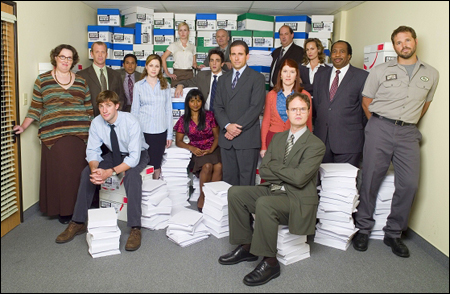
AMERICAN WORKMANSHIP: The cast of the US version of The Office |
Nobody expected this. When NBC trotted out its version of The Office last spring, fans of the original BBC series reacted in one of two ways. They either dismissed it out of hand as an automatic failure, or they reasoned that while it could never approach the original, it could still be a fun diversion. But after a wobbly first season, the stateside show, which has its third season premiere tonight, September 21 — a cushy slot on NBC’s primetime lineup — has become the funniest show on television (now that Arrested Development has been put to bed). It won a deserved Emmy for best comedy, and, most importantly, people have stopped dismissing it based on their love for the English version. In fact, in the blogs and messageboards across the land, people are starting to legitimately ask the question: which one is better? US or UK? And the idea that the answer just might be “US” seems a lot less absurd than it did a year and a half ago.
To say the US version is better than the UK version isn’t a slight on the English one. In David Brent, Ricky Gervais created a brilliant, unique character — the slimy boss who tries too hard to be your friend; he’s smarmy, manic, self-absorbed, deluded, and oblivious, and during the first season, he — and the show — achieved comic heights that that will be difficult to match.
But in series two, the show took a tragic turn, as we watched Brent get his comeuppance. And frankly, seeing him unravel proved consistently more sad than funny. Situations that generated laughs in the first series produced winces and, ultimately, pity. It’s a credit to the show that they made you feel sorry for that guy, of course, but that didn’t help the show’s immediate watchability.
Steve Carrell’s Michael Scott is a similar character to David Brent, but he’s able to find a form of redemption — no matter how temporary — within each episode. He displays his vulnerabilities, and his employees pick up on them in a way they didn’t do in the UK version. He might be a jackass and a dork, but they’d miss him if he was gone. The whole thing feels a lot less mean, and as a result, it’s easier to laugh at Michael when he embarrasses himself, knowing he’ll get thrown a bone later on.
Carrell’s outstanding, but that’s hardly surprising. Unlike the rest of the American cast, he was, at very least, a known quantity. More of a surprise has been the work of the first-tier supporting cast members, particularly Jenna Fischer as Pam Beesley and Rainn Wilson as Dwight K. Schrute. While the romantic “Sam and Diane” tension between Pam and Jim Halpert (Newton native John Krasinski) — a storyline imported directly from the Beeb’s version — felt forced in the early goings, it’s become more believable as the show has progressed. The two have genuine chemistry, owing in large part to the wide-eyed, enthusiastic way Fischer plays Pam. Pam’s British counter-character Dawn (Lucy Davis) spent a lot of time moping at her desk with only hint of a genuine personality. The US version further fleshes out Pam as the cool girl who’s stuck with a hopelessly lame jock. Krasinski, for his part, does a lot with Jim the everyman by making him the nicest guy in the office (pranks on Dwight excepted).
And as great as Mackenzie Crook was in the role of Gareth Kenan, the power-hungry sycophant with a military background he’s a little too proud of, Crook’s got nothing on Wilson’s Dwight K. Schrute, who’s even more sycophantic and more power-hungry — the type of dude who’s way into paintballing and sci-fi/fantasy films. And the way he makes gun noises with his mouth and pumps his fist in excitement over almost everything Michael announces is priceless.
The idea that entire episodes could be built around characters other than Gareth, Tim, Dawn, or David never occurred to Gervais and co-creator Stephen Merchant. But the writers of the US version recognized, and smartly, the opportunity these characters represent. And Toby, Oscar, Meredith, Angela, Phyllis, Stanley, Kevin, Kelly, and Creed all generate huge laughs, too. Give some credit to Greg Daniels, the executive producer, writer, and the man responsible for bringing the show to America in the first place — he knows a thing or two about incorporating a large ensemble of fringe characters from his time on The Simpsons.
Ultimately, all comparisons are odious, and this one is certainly imperfect. Starting tonight, with the opening of the third season, all of this could be irrelevant. They may well take it down the same path of tragedy that the British version did. So far, the US version has kept the UK’s “one branch must close” storyline relegated to the background, therefore avoiding the gloom that the BBC’s Office had. And indeed, the second season closed with Jim confessing his feelings for Pam, a situation that could potentially become less funny no matter what happens between the two of them. But given what the show has done so far, there’s no reason to think they can’t keep it up.
