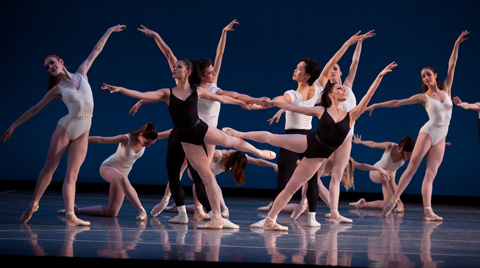
STILL A STUNNER Balanchine’s Symphony in Three Movements is 15 minutes of organized stampede, with a weirdly introspective duet squeezed in the middle. |
Boston Ballet is ending the season with four prime examples of ballet choreography, displaying not only the rigors of classical technique but the different kinds of images technique can be crafted to evoke. The "Balanchine/Robbins" program, which includes two works apiece by the 20th-century masters, runs through May 22 at the Opera House.Divertimento No. 15 (Mozart) and Symphony in Three Movements (Stravinsky) are poles apart in style, but both disclose the inventive genius that's never been matched by George Balanchine's imitators. I think the pleasure of classical music — and Balanchine's classicism, too — lies in following the surprises and intricacies that can be wrought from a set of basic materials. Balanchine starts his Divertimento with symmetry befitting an 18th-century drawing-room and pretty much sticks to it. Except that the two women leading the eight-woman ensemble turn out to have equal status with the three female and three male principals. This makes for extended solo and duet possibilities, but it also subverts the hierarchy that by tradition distinguishes principal dancers from corps de ballet. In another turn-about, the Minuet is danced by the corps women, partnering each other graciously with no need for male escorts.
After a group introduction, two of the men begin a long string of variations by showing basic moves in alternation. The five women and the other man follow with solos, each one sparked by the one before. James Whiteside captured the rhythmic potential in Balanchine's choreography, adding excitement to his natural fine line and largesse with clear distinctions between quick and sustained steps, big ones and small ones. Lorna Feijóo looked pleased as she pulled off her allegro variation. The others offered the strained smiles with which the company routinely glosses the effort Balanchine costs them.
Balanchine is not something you get the hang of right away. He dreams up startling combinations of steps and plots them meticulously, like another line of musical orchestration. But conquering the difficulties doesn't consign dancers to anonymity. His best interpreters manage to find their own voices. Here, and in the Symphony in Three Movements, the dancers had the technical chops to do the choreography, but few of them had the security to use it.
Symphony was the first big work of New York City Ballet's astounding 1972 Stravinsky Festival — a solid week of Stravinsky, 31 ballets encompassing 21 premieres. Symphony in Three Movements stunned me then, and it still does. If I say it's one of Balanchine's "modern" ballets, you might think of the kinks and conundrums of Agon or Four Temperaments. Symphony isn't like that at all. It's 15 minutes of organized stampede, with a weirdly introspective duet squeezed in the middle.
The dancers are divided into three units: a corps of 16 women in white leotards and tights, five men and five women in black and white, and three women soloists in pink with three male partners. But only one pair of the featured dancers (Whiteside and Lia Cirio on opening night) perform the extended duet.
