McCoy Tyner at the Regattabar, December 27, 2007
By JON GARELICK | December 31, 2007
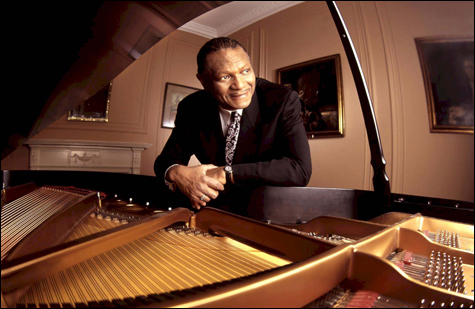
McCoy Tyner |
In recent years, McCoy Tyner has looked frail for his age — once robust and round-faced, he now appears gaunt. But the long-ago John Coltrane sideman still roars at the piano. On last year’s McCoy Tyner Quartet (McCoy Tyner Music/Half Note), he led a stirring live session with saxophonist Joe Lovano, raining down torrents of notes. At the second set of the opening night of his three-day stand at the Regattabar last Thursday — with special guest trumpeter Christian Scott joining his band — he was just as powerful.
Tyner, now 69, walked slowly to the piano, and sitting behind the instrument — heavy-lidded, unsmiling, courtly, his jaw jutting forward — he was an African-American Don Corleone. But as he unfurled the chords of the opening “Walk Spirit, Talk Spirit,” culminating in an orchestral glissando before cuing in the rest of the band, it was all there. Tyner is known for power and velocity, but he also has an uncommon touch, as distinctive as Hank Jones or Horowitz, a tone as big and well-modulated and full of warm brass as the Count Basie Orchestra. “Walk Spirit, Talk Spirit” rode a Latin-flavored, minor-keyed ostinato, driven by Gerald Cannon’s bass and the hiss-and-tock of Eric Kamau Gravatt’s cymbals and rims. Here and elsewhere, Scott dug into the minor-keyed darkness, and we were suddenly in the outer reaches of classic hard bop.
Tyner’s own playing was mostly chordal — on pieces like Coltrane’s “Mr. P.C.,” he took his big rumbling harmonies to the edges of tonality. But I missed his particular way with speedy single-note runs — his knotty patterns are like no one else’s. There was a bit of it in the solo pieces, where his style reached back beyond Coltrane and hard bop to early swing. There were hints of Earl Hines stride or Tatum-esque-runs in “For All We Know” and “Darn That Dream.” And occasionally those skittering lines snuck through between phrases of the melody — as though there were still too much to get in, too much left to say.
 Related
:
The anxiety of influence, Standards, One night, one jazz trifecta, More 
- The anxiety of influence
“I’m playing changes!” That’s what a young jazz-pianist acquaintance of mine announced exultantly to one of his musical buddies back in the early ’70s.
- Standards
For much of his life, no one played Thelonious Monk pieces except Thelonious Monk.
- One night, one jazz trifecta
True, there aren't enough paying gigs for musicians, but the live music is out there — and last Wednesday, I had to scramble to make three promising shows.
- The talk of the town
With the Boston Globe Jazz & Blues Festival defunct and no other significant local jazz fest in sight, the Beantown Jazz Festival has been stepping up to fill the void.
- Holy spirit of the saxophone
John Coltrane died 40 years ago this past July at the age of 40 of liver cancer.
- Fully loaded
One of the most hotly anticipated concerts of the season will be JOSHUA REDMAN's "Double Trio" concert at Berklee on January 22.
- Boston feasts
The Boston Symphony Orchestra, Celebrity Series, Emmanuel Music, Boston Early Music Festival, and more.
- Changing lives
People who love the arts are fond of saying that art changes our lives. Slideshow: The New England Conservatory’s Youth Philharmonic Orchestra visits Venezuela and Brazil
- Noble melody
For the first time since James Levine became music director of the Boston Symphony Orchestra, this acclaimed Verdi specialist conducted the BSO in a Verdi opera.
- The Big Hurt: Weezy unplugged
Our dream of a post-racial America moved one space closer to "king me" on the checkerboard of terrible metaphors this week
- The Big Hurt: Enduring the Billboard ‘Active’ chart
If you're not in the radio business, you might not know the term "Active Rock." It's not a genre, thank Heaven, but a radio format — the worst radio format.
- Less

Topics:
Live Reviews
, Entertainment, Music, Jazz and Blues, More
, Entertainment, Music, Jazz and Blues, Bebop, John Coltrane, McCoy Tyner, McCoy Tyner, McCoy Tyner, Christian Scott, Earl Hines, Less
