 |
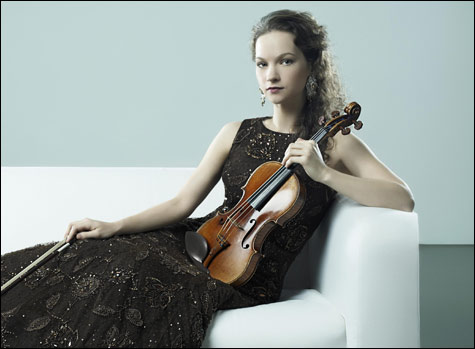
Now 30, Hilary Hahn — who plays Prokofiev's Violin Concerto No. 1 with guest conductor Rafael Frühbeck de Burgos and the BSO this weekend — has been in the celebrity-soloist circuit since making her major orchestra debut at the age of 15. Well schooled in standard repertoire, she's a multiple Grammy nominee, and that includes a win for Best Instrumental Soloist Performance in 2008 for her Deutsche Grammophon disc of Schoenberg and Sibelius violin concertos with Esa-Pekka Salonen and the Swedish Radio Symphony Orchestra. Known for the honesty and intelligence of her performances, as well as her virtuoso flair, she's also up-to-the minute in her use of the Internet (she even posts on her own YouTube channel) and has collaborated with singer-songwriters Josh Ritter and Tom Brousseau and the rock band . . . And You Will Know Us by the Trail of Dead. We chatted on the phone after she'd spent the afternoon snorkeling outside Reykjavík, relaxing following a performance of the Prokofiev concerto with the Iceland Symphony. We talked about repertoire, crossover, and the daily life of a soloist who plays about 50 orchestra performances and 30 solo recitals per year.
You'd think the Prokofiev Violin Concerto would have become part of the standard repertoire by now, but it's actually not performed that often. What appeals to you about it?
It's got this mercurial quality. It's always changing — just as you think you've got it pinned down, it shifts off in some other direction. In a good way, not a distracted way. I think Prokofiev just knows when to leave you wanting a little bit more and when to introduce a new idea. I love the lyricism. The way he wrote for all the instruments is both transparent and complexly interwoven. It's really beautiful — the moments that are kind of dreamy and mysterious — and then it's really hard-hitting when he decides to go into something rhythmic.
You've played with a few pop musicians, but you have some pretty specific ideas about what constitutes crossover.
Crossover is where you create a combination of genres and you alter a genre to represent another genre. Suppose someone plays electric violin in a band, and then they acoustically play a Mozart violin concerto like it's written: it's not crossover, it's Mozart. The person is playing Mozart as classical music. But if you play a Mozart concerto on an electric violin with a rock beat in the background, to me that's crossover. It's not like a classical musician playing along on someone's song. That's just a musician playing in that genre. So if I'm playing in the singer-songwriter, indie-folk genre, I'm not playing classical music right then, I'm playing their genre. So it's not really crossover. Just because I play classical music doesn't mean I am classical music. I'm not against crossover. But the projects I do with non-classical musicians, I like to do them in their territory. I like to go into their worlds, because I'm forced to jump into something I don't know and figure out how to handle it.
