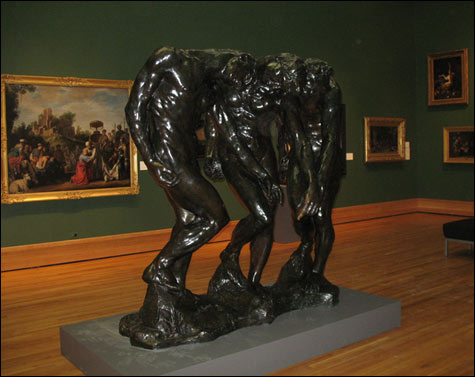
ATOP THE GATES: "The Three Shades," bronze sculpture, by Auguste Rodin. |
| "RODIN: THE KNOWLEDGE OF A THOUSAND GESTURES" | through August 3 | at Bowdoin College Museum of Art, Brunswick | 207.725.3275 |
Auguste Rodin (1840-1917) was one of the greatest sculptors in history. His best known work, "The Thinker," has become an icon recognized the world over. There's no version of that piece in the current show at the Bowdoin College Museum of Art, but there is a comparable piece, "The Thee Shades," which occupies the top of his monumental, and unfinished, magnum opus, "The Gates of Hell." ("The Thinker" also appears in "Gates.")There is, I think, a simple way to think about "The Thinker" that reveals much about the basis of Rodin's ideas. It looks perfectly natural, but the pose, with the figure's right elbow upon his left knee, is not a comfortable one. No one would use that posture for contemplation. Rodin's works appear realistic but aren't. His distortions create the tremendous feeling of force that animates all his best work, large or small. There is some irony in the fact that in his early days he was accused of casting from directly from the model.
The Bowdoin show consists of the large group, "The Three Shades," as well as some other, smaller pieces that belong with the "Gates of Hell" project as studies or details; a maquette for "Gates" that is quite different from the final version; some of Rodin's wonderful graphic work; and some smaller, stand-alone sculptures.
"The Gates" was never finished, but it is in the nature of bronze sculpture that parts and pieces can be enlarged, reduced, reassembled, or used for other purposes. Rodin was very successful in his lifetime and maintained an extensive atelier, with stone carvers, assistants, secretaries, and modelers. He made multiple copies of some works, while others, like the "Monument to Balzac," weren't executed in bronze in his lifetime. He made arrangements before he died with the Musûe Rodin to allow new casts after his death, which is how we can have "The Three Shades" in Brunswick. He personally worked mostly in clay and plaster.
The three figures in the "Shades" feel monumental, but are really only about six feet tall. In the last version of the "Gates of Hell" they stand on top of the outer frame, gesturing down to the center of the gates where the unfortunates must pass. Interestingly, in that version of the "Gates" they are also pointing directly at "The Thinker," who occupies the lintel over the doors. Again, the figures are distorted — the pointing arms are too long and the line across the shoulders behind the lowered heads is too straight. The whole effect is to concentrate the entire physical focus of the three bodies into the single, pointing finger of the central figure. This amplified gesture is an indicator where the approaching sinner must go and a chilling order to continue the passage.
Rodin invokes Eros in some of the smaller works like the intertwined bodies of the two women in the oddly titled "Ovid's Metamorphosis" and the male and female bodies of "Fugitive Love." It its broadest sense, Eros represented creation as well as sexuality, and there a feeling in his work that the piece is being created as you are looking it, that you are seeing an event that has a history and a future.
He was a master at making the physical presence of his work so resonant that the attentive viewer gets a visceral response. All really good sculpture has this same quality that it is really there, that it is more than simply a graphic construct with a front and back. Rodin's sometime student Brancusi could do it, as could Matisse in his sculpture, Maillol and, later on, David Smith, John Chamberlain, and Richard Serra. They are, to some degree, all descendents of Rodin.
Ken Greenleaf can be reached at ken.greenleaf@gmail.com.
