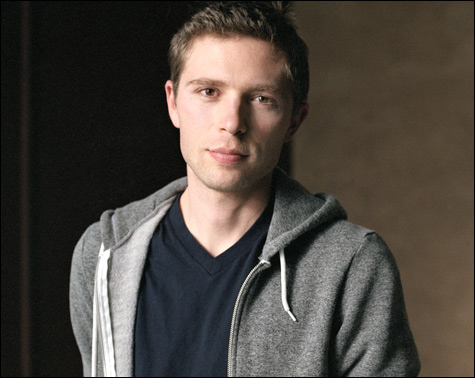
UNSTUCK BRAIN Jonah Lehrer.
|
Those of us aching for a 300-page treatise about the crippling implications of the "build your own scramble" at Local 188 won't, at first glance, find a great deal of solace in Jonah Lehrer's second book, How We Decide. Like Malcolm Gladwell's new book, Outliers, Lehrer examines our capacity for success and failure through the lens of figures in extraordinary circumstances: a quarterback in the clutch during the Super Bowl, a smokejumper trying to save his hide in a blazing wildfire, a world-famous opera singer who loses her confidence and can no longer sing. If this approach seems somewhat derivative and formulaic, Lehrer's grasp on emerging revelations JONAH LEHRER reads from How We Decide | Houghton Mifflin Harcourt | 302 pages | $25 | at RiverRun Bookstore, 20 Congress St, Portsmouth NH | April 15 @ 7 pm | Free | 603.431.2100 |
in neuroscience affords his book a great utility. Even if we'll never face an onrush of 300-pound linebackers, we still need to know when and whether to trust our first instincts — and when we shouldn't.Lehrer, just 27, is becoming something of a wunderkind in the realm of popular science. A Rhodes Scholar, New Hampshire resident, and editor-at-large at Seed magazine, he's written for the New Yorker and numerous other publications since the release of his 2007 book, Proust Was a Neuroscientist (see "Senses Come Alive," by Christopher Gray, February 15, 2008). That book's thesis (many of history's great artists created prescient work explaining how our brains operated decades or centuries before science could) was compelling, if somewhat anecdotal (Proust was neither a neuroscientist nor an influence on the field). How We Decide has a similar structure to Proust — anecdote, neurological explanation of anecdote, how this new knowledge can inform and benefit our lives — but its intent is more practical, and Lehrer excels at prescribing ways to approach both everyday and exceptional dilemmas without seeming pedantic.
The warring factions in the brain's frontal lobe make it a wonder that we're ever able to make decisions at all. This is the rational area of our brain, unique to humans and (to an extent) primates, where our common sense and emotional urges duke it out. The neurons that transmit the chemical dopamine, supplying wisdom based on experience, have to cooperate with our powerful (and bustling) prefrontal cortex, which regulates our impulses and self-awareness, which is fielding concerns from our amygdala, which is naturally averse to loss, and so on.
Weaknesses or failures of any of these areas can be disastrous. Lehrer says scientists now suspect that schizophrenics suffer from hyperactive dopamine neurons, those with reduced activity in the amygdala cannot empathize with — or even perceive — emotions in others (it's a common trait of serial killers), and as for the prefrontal cortex: it's what's destroyed in a frontal lobotomy. Lehrer uses dramatic examples of these areas in extremes in order to shed light on our mind's activity in more quotidian circumstances. The gambling addict is responding inappropriately to the same rush of dopamine as the shopper compelled to buy a pair of jeans she doesn't need because they're 50 percent off. Despite all this competition and all of the mistakes we make, the brain is miraculously and rather mysteriously able to "supervise itself."
Lehrer's confident prose is liveliest when showing us how the brain's inner-workings contradict theological and philosophical theories. Addressing Kant's assertion that morality is based on logic, Lehrer explains how our conceptions of right and wrong are actually quite instinctual, emotional decisions, which we use our reason to defend. (This is the basis for many of our political and aesthetic opinions as well.) "These moral instincts aren't rational," he says, "they've never heard of Kant."
At the same time, he's sensitive to and aware of the flaws in our wiring. We frequently and inevitably make mistakes — we look to our guts when a moment of careful thought is more appropriate, and vice versa — but we have (at least) the capacity to learn from them. Lehrer lays out when we should make certain types of decisions in his "taxonomy of decision-making," with the overriding suggestion that we "think about thinking:" even when a whimsical, merely aesthetic choice may prove to be your best option, acknowledging that fact is important; it'll make you a more confident actor. While Lehrer doesn't get around to a few obvious questions — the ultimate "heart vs. head" realm, romance, for one — How We Decide may at least make you stop being the guy who has to order last and, even so, blurts out an order in an uncertain bluster every time he goes out to brunch.
This book got Christopher Gray to cut up one of his credit cards. Collection agencies can contact him at cgray@thephoenix.com.
