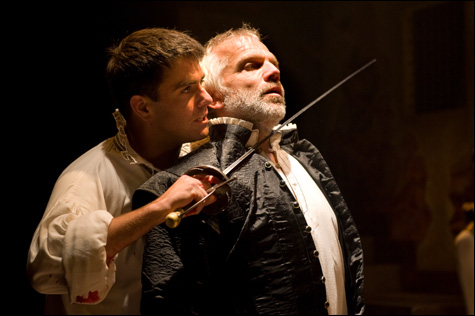
WEAKNESS AND STRENGH: Kidd and Donelly. |
Political intrigue and peril, romance and swordplay, parallels to today’s electoral brouhaha, and reminders of historical warnings, all presented in dignified but unpretentious blank verse cadences. Friedrich Schiller’s Don Carlos has it all, at least in the adaptation written and directed by Tony Estrella, which is premiering at the Gamm (through October 5).When people speak of a production of Don Carlos, they’re usually referring to the opera by Verdi. There was a London adaptation of the play in 2005, but the late 18th-century work by Schiller, staged two decades before the opera, is known mainly to comparative literature students. Written to run six hours, full of lengthy disquisitions on politics and power and religion, even in its own time it was ruthlessly chopped down by directors for actual performances.
Don’t check your history book if you want the end to be a surprise, but you might check the original Schiller version if you want to put in perspective its length at Gamm (less than three hours, including intermission; see sidebar) and complicated plot (a flowchart would be helpful, to follow who is deceiving whom; see below).
Don Carlos (Steve Kidd) is the heir apparent to the throne of the Spanish Empire in the late 16th century. At the opening, he hardly appears to be a prince of kingly bearing, weeping as he is over a handful of old love letters. The current queen, Elizabeth (Georgia Cohen), his stepmother, used to be his fiancée. His father, King Philip II (Richard Donelly), stole her as much out of lust as from political convenience, allying with her native France. Elizabeth doesn’t want anything to do with Don Carlos, being the kind of girl who keeps her head.
The lust noted above courses through this play like a river with numberless tributaries. Philip also has flaring nostrils for Elizabeth’s sister, Princess Eboli (Amanda Ruggiero), who in turn schemes to meet secretly with Don Carlos, who arrives only because he thought Elizabeth had relented. Poor Eboli, whose only claim to dignity is a tearful speech lamenting the plight of young princesses usually forced to marry graybeards twice their age.
Kidd presents Don Carlos effectively, though our empathy is reduced by the character being so weak and vacillating at times — especially in contrast with Donelly’s powerful Philip, whose stern glance is more unsettling than the prince’s anger.
Despite being a supporting character, Rodrigo, the Marquis of Posa (Alexander Platt), is the strongest presence in this play, both from his crucial role in the story and through Platt’s stern but restrained acting. Rodrigo is a soldier who has recently proved himself valorous in Flanders, and he is also an old friend of Don Carlos, loved and trusted. Not to give away too much of the story, let’s just say that his attempt at fortifying the prince against the injustices of the Inquisition and promoting rebellion against Philip’s iron-fisted rule takes twists and turns.
Other characters keep stirring the bubbling cauldron that is this court. From the outset, the Catholic prelate Domingo (Christopher Francis Byrnes) and the Duke of Alba (Normand Beauregard) conspire to fan rumors and encourage deceptions, for their respective advantages of church and personal power. Poor Count Lerma (Tom Gleadow); the king’s principal aide does what he can to help Don Carlos, but to no avail.
By the time the Grand Inquisitor (Sam Babbitt) shows up, dressed in diabolical red, holding a staff that might as well be a trident, his self-righteous speech about the rightful primacy of the Church in maintaining order among sinners and heretics sounds not unlike a political acceptance speech. He is scary-eyed (contact lenses) and blind, a nice metaphor.
The set design of Sara Ossana opens up hellishly in that scene, glowing crosses behind and below — the opening in the floor, full of hot coals, had earlier been used to roast a heretic to death. The design is also impressive for frescoes right and left. The costume design by David T. Howard is realistic to the period and opulent as all get out, from musketeer boots to silk and satin finery. Sound design by Charles Cofone and lighting design by Matt Terry well perform their subtle tasks of being most effective when least obtrusive.
The Sandra Feinstein-Gamm Theatre and its artistic director, Tony Estrella, have done well by Schiller, and once again for us.
