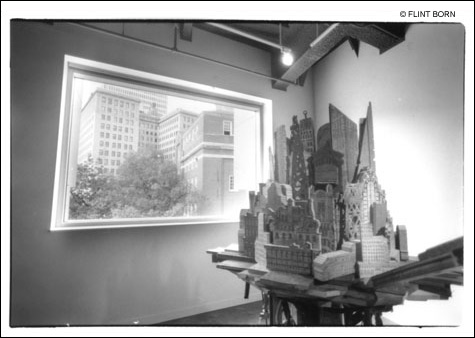
ROOM WITH A VIEW: The windows of the Chace capture the essence of the surrounding cityscape. |
Between the anxious days that followed 9/11 and the grim future that looms thanks to financial meltdown, several important New England art museums were able to exercise their edifice complexes in ways that will enrich the experience of arts lovers while maintaining the highest architectural standards.
In Boston, the Museum of Fine Arts in 2005 broke ground for an expansion of almost imperial proportions orchestrated by Norman Foster, whose practice has work in 150 cities in 50 na-tions.
In 2006, the Institute for Contemporary Art began a new life in a stunningly sleek waterfront building — itself internationally recognized as a work of art — designed by Diller Scofidio + Renfro.
Now comes the Chace Center at the Rhode Island School of Design Museum, poetically conceived and powerfully executed by Madrid-based José Rafael Moneo.
Moneo superintended the expansion of the Prado, one of Europe’s most aristocratic institutions, as well as Houston’s Museum of Fine Arts, a center of go-go in a city of unabashed strivers.
Named after the family that is the principal patron of the five-story, $34 million teaching, research, exhibition, and commercial mixed use building, the Chace Center elegantly reconciles the potentially conflicting demands of energy and reflection. Its public spaces have an intimate quality. Its classroom studios will be energized by the proximity of the museum-going public.
Moneo’s Chace Center is a place where art will live — in conception, execution, and display.
In and of itself, that would be a noble accomplishment.
Moneo, however, has pulled off something more elastic, more resilient, and more exciting.
The Chace Center punctuates the already handsome, largely 19th-century North Main Street cityscape with a vigorously restrained infusion of modernity, drawing strength from the work-a-day utility of its neighborhood.
In return, the Chace reenergizes North Main, reaffirming and complimenting the variety of fine and humane architectural values already in place. Moneo’s building politely — but with no equivocation — invites a contemplative reappraisal of the past from a 21st-century point of view. What today is striking will tomorrow be merely beautiful. A sense of continuum is in play. An architect less confident than Moneo might not have had the aesthetic maturity to achieve this effect.
With its brushed aluminum, acid-etched glass, and brick, Moneo’s Chace is imaginatively situated in the moment. The depth of its achievement is that as it endures, the Chace will reorder the daily experience of those students, teachers, and staffers who work there, as well as patrons who visit the RISD Museum. Its courteous accommodations of scale will be best appreciated over time, which I am confident will judge Moneo’s work as magnificent because of its modesty.
This most contemporary building draws its power from its restraint, harmoniously transcending the limits of space to fuse — organically — with its urban landscape, engaging the confines of its place at the crowded foot of College Hill to connect with the downtown across the Providence River.
The Chace is a conceptual pivot. It tangibly anchors RISD’s expansion downtown (its dormitories and library in the old Hospital Trust building) with its East Side campus. As such, it is a political as well as a planning success, suggesting harmony and community.
Words and images on a page or screen can evoke or suggest only so much about any building. The ultimate proof is in the experience of visiting or inhabiting. In this regard, the Chace wins with wonder. As with any museum, windows are scarce to protect exhibits from — in this context — the corrosive effects of sunlight. The windows of the Chace are ingeniously situated in such a way as to capture, perhaps even enhance, the essence of the surrounding cityscape.
For museum goers and the RISD community, Providence is captured and displayed. The city that plays host to the Chace becomes part of a permanent exhibit to those inside the building. Thus does RISD’s Chace Center pay tribute to Providence: by engaging the city according to Moneo’s vision.
