A TOUCH OF GRAY: Charcoal and quilled
black paper. |
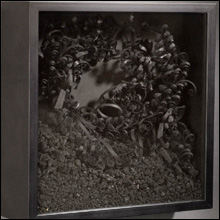
Lauren Fensterstock’s new show is black and dirty. Piles of deep charcoal deposits fill the front window area of Aucocisco Gallery and create surprising landscapes. Left to its own devices, the charcoal stakes claim to a certain kind of power, pure and of the Earth. Fensterstock juxtaposes this natural element with highly stylized paper worked into ornate shapes by a historic technique known as quilling. Meticulously formed by the artist, jet-black paper finds a new center of gravity in flowering and fern-like shapes. Some pieces are hung on the wall in deep frames, putting the rough, loose charcoal at odds with the cultured paper, simultaneously swallowing it up and providing a base for its existence.
The quilling technique you use to make these pieces is very distinctive. How did you arrive at it?
This is something I played with three or four years ago. I made one piece that took about seven months to make. It was a moment when I didn’t know what I was doing in the studio. I had been doing a lot of metal-smithing, everything was very permanent and I needed to go somewhere else, I needed some sort of shift. When I started the quilling project, I wasn’t making it archival, just using Elmer’s glue. I started to realize that it might fall apart in less time than it took me to make it. It was a liberating realization and changed the whole direction of my work. I started making things looser and more ephemeral.

I did that one piece back in 2003 and moved on. I focused on decorative objects, culture represented by what people keep in their homes. Then I read this book by Simon Schama, Landscape and Memory, all about nature as a cultural object. I grew up in New York and to me nature is something that you look at (from) the climate controlled space of your car. I started looking at nature as a cultivated object. Looking at Renaissance gardens, Baroque gardens, different ages representing different powers and different classes.
And with this new mindset came new work?
The title of my show “A Third Nature” comes out of the Italian Garden traditions of the Renaissance. Cicero wrote about the concept of a second nature to describe man’s built environment, specifically what we build on top of nature — roads, bridges, buildings. The existence of a second nature implies that there is already “a first nature” which can be identified as the natural world as created by God. During the heights of the Italian Renaissance, landscape theorists came up with the idea of “a third nature,” which expressed a new style of working the earth. “A third nature” represents a partnership between the first and the second. Here, man re-creates the world as a cultural construction; the world of man revisions the world of nature and supposedly improves it. In this way “a third nature” suggests an attitude about the world, where men create in their own image, ruling, conceiving, and forming — Gods of their own terrain. I find that brazen vantage point to be completely audacious but wonderfully idealistic — and very seductive. I struggled for a year looking at nature, making geodes, working with piles of natural elements. I did a show at Kohler Arts Center in Wisconsin where they wanted to use that quilling piece from 2003. Looking at it again with my new interests, I saw it representing this stylization of nature I’d been investigating.
So, given the context of this development in your artwork and your interests over the last few years, can you see where your future work is headed?
This is new terrain for me. I tend to get really interested in a topic that I don’t know about and use making as a process of figuring it out. Once I come to lots of conclusions, I usually stop and go somewhere else and start over. I see myself as more of a research historian than as an artist. Making is more of a remnant of that process. For me, the natural world is so unknown and unfamiliar. I’ve also been working very small scale — those windows [installations in the front of the gallery] are an attempt at moving towards a larger scale. For the upcoming show at Bowdoin College I’m actually going to do a really big piece. Something you can walk through.
That’s a lot of quilling!
I have a year!
Email the author
Ian Paige: ianpaige@gmail.com
