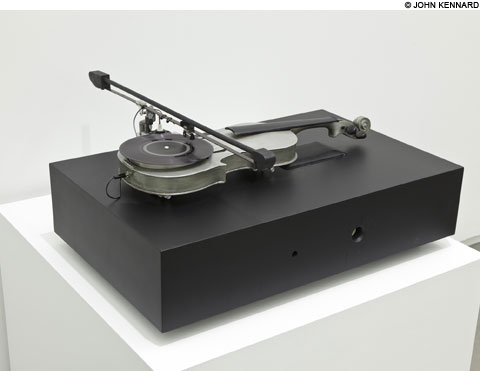
Viophonograph Laurie Anderson’s customized violin has the power of a holy relic, but much of “The Record” feels like covers of ’50s greatest hits. |
Catherine Opie first became known in the early '90s for blunt lesbian self-portraits and posed photos of the queer community. They were both deadpan documents of her people and fierce political broadsides. In 1994, she photographed herself topless, with needles studding her arms, a black eyeless mask buckled over her head, and the word "pervert" cut into her chest.But the new millennium found her taking quiet shots of her young son, her partner, their dogs, their Los Angeles neighborhood. That is, until photographing a football tailgate party, a Martin Luther King Jr. parade, and a protest against sex offenders in her community got her thinking.
"I had missed street photography," she tells me at the press preview for "Empty and Full," a survey of the past five years of her work at the ICA. "And I didn't know that I had missed it until I started looking at that. I realized that, okay, everybody's taking photographs of flowers and other things. It seemed like the art world became apolitical to a certain extent post-9/11. I wanted to go back to the street and back to the people and back to bearing witness."
Organized by Helen Molesworth, "Empty and Full" includes photos of a 2006 immigrant-rights march and a 2007 peace march in Los Angeles, Obama's 2009 inauguration in DC, a 2009 rally in support of same-sex marriage in California, and a 2010 Tea Party rally in San Diego.
In counterpoint, the gallery's outer walls display photos of the Pacific Ocean, recording consecutive sunrises and sunsets from aboard a massive container ship that Opie rode for 11 days from Korea to California. She winks at the cheesiness of sunset photos, but she's serious. They could be said to mull the existential vastness of the sea, or the nature of international commerce, how it links disparate parts of the globe, as well as what environmental damage it might cause. But the photos seem more about abstraction. She bisects the frames into blue-on-blue zones of open sea and sky. The shifting moods of the water read like Rothko paintings — humming, æthereal, meditative — but also as somewhat bland. In recent years, Opie has adopted a digital camera that mimics the effects of large-format film cameras; these can seduce you with their seemingly endless detail, but they can also be a crutch.
Her rally photos show sober anti-Iraq War protesters carrying flag-draped faux coffins and Tea Partiers smiling as they wave flags and signs saying, "Stop the Spending." She doesn't glorify or demonize, and she lets the messiness of the events show. The results are more interesting for their subjects than for their dispassionate æsthetics. Which may reflect Opie's own ambivalence. With her early queer portraits, she says, she hoped to "have somebody rethink their homophobic tendencies. Now I realize that I'm never going to be able to make somebody who's homophobic not homophobic. And in the same way, I'm never going to be able to make a Republican not a Republican. We as humans need to connect to this kind of profound unmovable sense of ideology that we create for ourselves."
