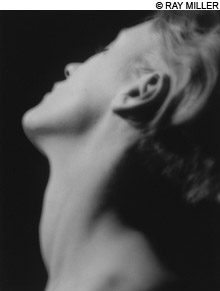
NECK Miller and Ray fought over this portrait of her. |
It was July 1929 and Lee Miller was looking for the Surrealist artist Man Ray. At his Paris studio, she was told he had left town for a vacation, so she repaired to a nearby bar for a Pernod. As destiny would have it, Ray came in and they were introduced. She said something like: "My name is Lee Miller, and I'm your new student.""I don't have students," Miller remembered Ray replying. "He said he was leaving for Biarritz the next day, and I said, 'So am I.' "
So they went together, becoming collaborators and lovers. "Man Ray | Lee Miller, Partners in Surrealism," organized by curator Phillip Prodger at the Peabody Essex Museum, is an impressive exhibit of 76 photos, paintings, sculptures, and letters that came out of their steamy three-year affair, plus art by their pals — Picasso, Calder, Le Corbusier. The show aims to reframe their relationship: "Historically, Miller has been described as Ray's muse," reads the catalogue, "but their brief, mercurial love affair was in fact a key source of mutual and sustained inspiration, resulting in some of the most powerful work of each artist's career."
When they met, Miller was a 22-year-old American fashion model who epitomized the flapper look — short blond hair, blue eyes, lithe build. She appeared on the cover of Vogue in 1927 and posed for Edward Steichen, but she decided, "I would rather take a picture than be one." Ray, born Emmanuel Radnitzky in Philadelphia, was, at age 38, a "small, dark man with a torso like a bull" (according to Neil Baldwin's 1988 biography) who had planted Dada in New York with Marcel Duchamp in the 1910s. When he moved to Paris in the '20s, he became a top commercial portrait photographer and a star of the Surrealist gang.
At first, Miller and Ray rarely left his studio. When they weren't working side by side in his tiny darkroom, they were in bed. One result of their collaboration was their discovery of solarization (a technique known to commercial photographers) when something — a mouse? — scurried over Miller's foot while she worked in the darkroom. She flicked on the light, only to realize that she had probably ruined negatives she was working on. Turning off the light, she brought in an angry Ray, and together they developed the photos. The mistake gave the pictures an otherworldly black halo — which, in subsequent photos, Ray and Miller produced on purpose. In Ray's solarized circa-1930 profile of her, she shimmers like polished steel.
Ray favored photographing carefully posed scenes in his studio, often representing a dreamy interior world. He photographed Miller with the shadows of a lace curtain spider-webbing across her naked breasts and belly, or with her eyes closed and hair flowing back like the figurehead of an art deco ship. Miller found surreal scenes out on the streets — a line of rats perched on a rail, a trio of charging cows on a carousel, and mysterious reflections in a perfume shop window. In the studio, she had a feminist eye, as seen in her photo of a bell jar that appears to contain a woman's severed head.
