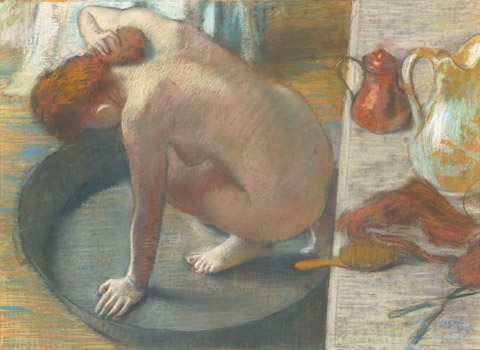
THE TUB There’s no swooning or come-hither stares — just ease, comfort, relaxation, and intimacy. |
One of the remarkable things about the Museum of Fine Arts under director Malcolm Rogers is its ability to straddle highbrow and lowbrow simultaneously. Its fall blockbuster exhibit "Degas and the Nude" (through February 5) is a perfect example — a splendid survey of a modern master as well as girls, girls, girls.From the Frenchman's portraits and paintings of race horses, laundresses, and ballerinas, the MFA's George Shackelford (who's leaving for Texas's Kimball Art Museum next year), and Xavier Rey of the Musée d'Orsay in Paris isolate 162 nudes (mostly ladies) by Degas and by a smattering of contemporaries like Ingres, Toulouse-Lautrec, Gauguin, Picasso, and Caillebotte. Instead of being pin-ups, Degas's pastels, monoprints, and paintings turn patient observation of women unselfconsciously stepping out of tubs and toweling off into intimacy and tenderness.
The show spans the entire career of Degas (1834-1917), from early academic copies of Rembrandt and Botticelli to awkward history paintings that he showed in the French Académie's annual juried salons beginning in 1865, to secret sketches of brothels in the 1870s, to paintings of the 1890s that became increasingly free and expressive in their use of color.
The sweet spot is the 1870s and '80s, when Degas pioneered his dramatic sense of lighting (perhaps derived from the ballet) and dashing pastels. It's most evident in his monotypes of prostitutes in their beds and women bathing indoors. Paired prints and drawings show how his signature pastels often illuminate the moody darkness of the inky monotypes with radiant strokes of color.
One of his finest artworks is his 1885 to '86 pastel Woman at Her Toilette, Drying Her Left Foot. Sharp outlines that hark back to his early delicate academic figure studies dissolve under loose pastel strokes that convey supple pink flesh revealed as the seated woman bends over to towel her foot, folding her other arm between her legs and belly. Purposely awkward poses, asymmetrical compositions and cropping reflect photography (Degas took up the camera himself in the 1890s; note his self-portrait photo here) and Japanese prints. Degas's attention to motion — in ballerinas, horses, and bathers (not included at the MFA except for a smattering of ballerinas) — also reflects his study of Eadweard Muybridge's landmark stop-motion photos of animals and people.
Shackelford and Rey aim to provide "a new interpretation of the artist's conception of the nude." We learn that Degas liked to make nude studies before he depicted ballerinas in their tutus. But the main takeaway is that Degas liked to watch from behind — buttocks, hourglass curves, breasts in profile, faces hidden, no eye contact, anonymous, voyeuristic.
Compare Degas's approach to his contemporaries: William-Adolphe Bouguereau, whose polished academic paintings of naked nymphs and classical deities represented everything the Impressionists were rejecting; or Pierre-Auguste Renoir, an Impressionist who continued to idealize women even as he painted contemporary life. What remains fresh about Degas's approach is how wonderfully ordinary everything seems. There's no swooning or come-hither stares — even when he sketches girl-on-girl action in brothels. There's a feeling of ease, comfort, and relaxation. And perhaps this makes Degas's nudes more sexy than his peers' in the way that amateur porn can be — or Manet's nudes were — because of the implication that this isn't fantasy, but reality.
Read Greg Cook's blog at gregcookland.com/journal.
