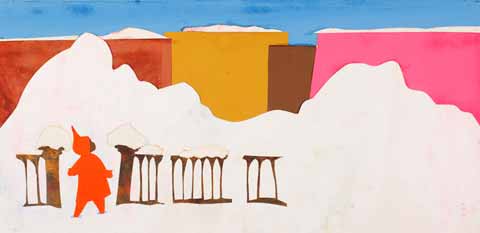
CLIMATE CHANGE A masterpiece of painterly control, Jack Keats's 1962 picture book The Snowy Day was a civil-rights landmark in its own right. |
Ezra Jack Keats published The Snowy Day in 1962 — around the time Freedom Riders were being beaten for trying to integrate bus travel in the South and James Meredith was being barred from the University of Mississippi.
The picture book — a civil-rights landmark in its own right — was a calm and beautiful and poetically simple tale, stylishly illustrated, of a little African-American boy named Peter, who is entranced when snow transforms his city neighborhood into a wonderland. It was one of the first times — and the most prominent occasion — that an African-American was the star of an American children's book. Previously, the most famous black children's book character was the racist caricature Little Black Sambo. The Snowy Day deservedly won the Caldecott Medal, which honors great picture books, the following year.
"The Snowy Day and the Art of Ezra Jack Keats" at the Eric Carle Museum of Picture Book Art (125 West Bay Road, Amherst, through October 14), organized by New York's Jewish Museum, marks the 50th anniversary of the book's publication with a survey of Keats's career (1916-1983). He grew up the son of poor Polish Jewish immigrants in Brooklyn. (The Snowy Day was a landmark for the integration of characters, but it would be years before children's publishing embraced black creators.)
SLIDESHOW: The Snowy Day and the Art of Ezra Jack Keats
The book is a masterpiece because of Keats's control. His expressionist brushwork animates watercolor rainclouds in 1968's A Letter to Amy, but his exuberant painting often got away from him. The eight spreads from Snowy Day here are pared-down compositions of big shapes and striking silhouettes in bright paint and collage.
Keats's other stories are often convoluted. Here the simple narrative — Peter making tracks in the snow, avoiding a snowball fight, returning home — is acutely attuned to childhood rhythms. Every page has words, except for one of Peter in his red snowsuit walking away from us, trailing purple footprints. Hear the snow's hush.
Most of our classic children's books are set in the country or magical foreign lands. Keats's work, instead, shows us urban America as we live it — but nudged toward an ideal: of tolerance as normal, of possibilities opened up, and of inklings of bigger adventures ahead.
BEYOND DISNEY
When Disneyland was developing the 1967 Pirates of the Caribbean ride, Marc Davis — a Disney animator-turned-Imagineer — realized that there wasn't much historical imagery of pirates to draw on: "The artist who really invented pirates as we see them now was an illustrator by the name of H.C. Pyle."
"Howard Pyle: American Master Rediscovered" at the Norman Rockwell Museum (9 Route 183, Stockbridge, through October 28), organized by the Delaware Museum of Art, is a retrospective of the brilliant American painter of manly adventure.
SLIDESHOW: Howard Pyle: American Master Rediscovered
Through his teaching (students included N.C. Wyeth, Maxfield Parrish, Jessie Willcox Smith) and popular magazine and book illustrations of Robin Hood, the Arthurian legends, the American Revolution, and pirates, Pyle (1853-1911) deeply influenced American culture — particularly Hollywood.
