NEW YORK — Lots of people have choreographed Steve Reich’s music. During his decades-long inquiry into speech, harmony, and electronics, his meditations on religious and social themes, his reconfiguring of the concert orchestra, and his challenges to individual musicianship, Reich has never abandoned rhythm. All his music, from the simplest to the most complex, has an underlying, unifying pulse that entices the body into movement. His major sources of influence — jazz, West African drumming, and Balinese gamelan — also depend on a galvanizing pulse and draw little distinction between musicmaking and dancing. As a dancer noted when introducing Akram Khan’s new Variations for Vibes, Pianos and Strings last week at the Brooklyn Academy of Music’s Next Wave Festival, “We’re working in the place where the music and the dance are one.”
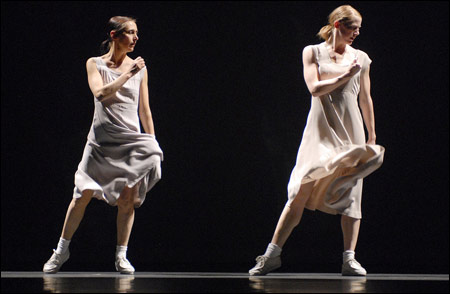
FASE: Moving in exact unison but not alike at all. |
Commissioned in 2005 for Khan and the London Sinfonietta, the Variations had its US premiere at BAM on October 3, kicking off a month-long 70th-birthday celebration for Reich that will spread to other big culture palaces of New York City. Khan follows an impressive line of choreographers who’ve been seduced by Reich’s music. The BAM concert began with a middle-generation Reichian, Anne Teresa De Keersmaeker, who revived her 1982 piece Fase. De Keersmaeker and Khan are as far apart stylistically as Reich’s new composition is from the austerities of Clapping Music. It’s a sign of Reich’s potency that contemporary dancers find him as compelling now as the dance avant-garde did 35 years ago. For me the whole evening was a trip — like flying across the Pacific through 14 time zones.
Curiously missing on stage, and in all the accompanying celebratory verbiage, was any reference to Reich’s first dance collaborator, Laura Dean. For five years or so at the beginning of the ’70s, Dean’s spinning-stepping dances and Reich’s rhythm patterns exemplified downtown minimalism at its most extreme and invigorating. (No, it never put me to sleep, just the opposite.) As dictated by the counterculture, symphonic form, dance technique, emotionality, and the star system were out the window. You did simple steps, four-note motifs, lots and lots of repetition so the audience could appreciate shifting accents and directions. Dean and Reich would be tracing basic geometric layouts, counting into the hundreds before anything changed, repeating bone-dry elements till they flowed like a waterfall.
Their collaboration culminated in the big ensemble piece Drumming (produced by BAM in 1975). Dean was already incorporating balletic steps, leaps, and fancy gestures. After Drumming she began to write and play her own musical accompaniments. Reich developed large-scale formats and continued to pursue the basics of rhythm with counterpoint pieces where one performer played against pre-recorded tracks of himself. Since the monastic early days, Reich scores have served Elisa Monte’s eroticism in Treading (1981), Lar Lubovitch’s sensuous journey in Cavalcade (1996), and Twyla Tharp’s balletic/soft-shoe marathon in the last part of Known by Heart (1998).
