"Black Womanhood" at Wellesley College’s Davis Museum and Cultural Center
By GREG COOK | September 23, 2008
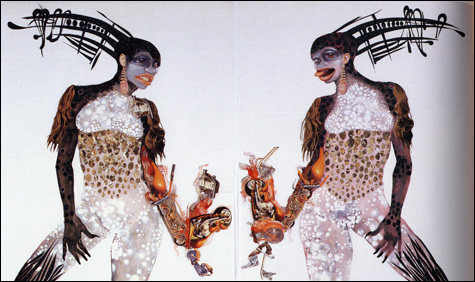
DOUBLE FUSE: Wangechi Mutu’s playful razzmatazz makes reference to the past but lives in
the present. |
| “Black Womanhood: Images, Icons and Ideologies Of The African Body” | Davis Museum and Cultural Center, Wellesley College, 106 Central St, Wellesley | Through December 14 |
“Black Womanhood,” the exhibit at Wellesley College’s Davis Museum and Cultural Center, must have seemed like a sharp idea when it was being put together. It examines the ways in which “contemporary artists are challenging historic and often stereotypical images that present black women as the alluringly beautiful Other, the erotic fantasy, or the super-maternal mammy.” By now this is familiar, if still urgent, stuff; what makes this outing special is that it gathers more than 100 objects — traditional African art, Western colonial photos and postcards, and contemporary art — that connect today’s dissectors with the origins of the ugly stereotypes they’re working to take apart.Barbara Thompson, who organized the show for Dartmouth College’s Hood Museum of Art in New Hampshire, does a good job of mapping the territory. But it’s an uneven show with a dour vision that leaves a mediciny taste in your mouth — and, I think, offers signs of a generation gap among curators.
The art of African women was traditionally pottery, beadwork, basketry, textiles, and the decoration of their own bodies (tattoos, scarification, hairstyles, body paint). But Westerners collected primarily African sculpture, masks, and costumes — which tended to be made by and for African men. The women’s portrayal of themselves was more abstracted, less obvious than their men’s literal, if stylized, depictions of women. The show presents women-made pots with bumps and patterns that make reference to women’s physiques and body scarification. The women’s pieces emerge directly from their work and their rituals — like a leather skirt beaded by an adolescent girl in her seclusion as she made the traditional passage into womanhood.
The most charged part of the show surveys early-20th-century Western photos and postcards of African women. Western attitudes are apparent in images that treated the women as curious ethnographic specimens and pin-ups — either untamed, sexually available African primitives or Oriental harem girls. Photographers tailored their shots to different audiences by photographing the same models elaborately garbed or in various states of undress. A postcard of a young topless Temne woman lounging on a rug was published around 1910 as “Timnie Girl, Sierra Leone.” When it was republished in the 1920s, the caption read, “Just you and me. Sierra Leone.” These postcards could be the foundation of an electrifying stand-alone exhibit.
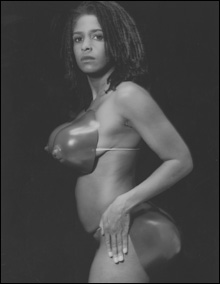
HOT-EN-TOT: More of the contemporary work
should have Renée Cox’s crackle and swagger. |
But “Black Womanhood” — primarily work by black women, with some contributions by men and whites — deflates as it moves to the art of today. Sokari Douglas Camp’s 1995 sculpture Gelede from Top to Toe is an African woman turned into an armored tank of steel and chicken wire with wooden breasts that jut out like battering rams. In Renée Cox’s giant 2001 photo self-portrait Baby Back, she imitates Jean-Auguste-Dominique Ingres’s 1814 painting La grande odalisque by reclining, with nothing hiding her brown skin except for red heels, on a gold chaise longue. Cox asks how race colors our notions of beauty, and she teases black-white, male-female hierarchies. Ingres’s naked white lady is an imagined harem girl holding a fan; Cox has a whip.More of the contemporary work should have Cox’s crackle and swagger. It should sadden, celebrate, anger. You’d think Kara Walker’s bawdy, violent versions of ante-bellum paper-cut silhouettes would be just what this show needs, but the 1997 pop-up book that’s here is too tiny to convey the fierce beauty of her best work.
 Topics
:
Museum And Gallery
, Culture and Lifestyle, Angelfood McSpade, Special Interest Groups, More  , Culture and Lifestyle, Angelfood McSpade, Special Interest Groups, Oprah Winfrey, Fashion and Style, Visual Arts, Hair Styling, Cultural Institutions and Parks, Museums, Women's Issues, Less
