THE COMMUNIST DRACULA PAGEANT: The greater point would seem to be that history is as much theater as theater is. |
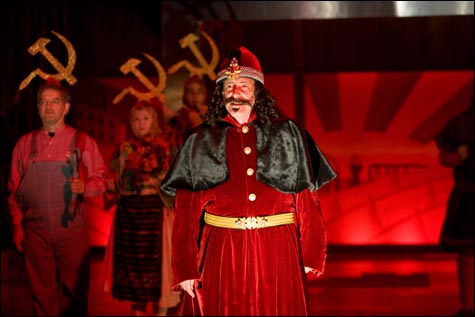
There is more pageantry than either Stalinism or Stoker in The Communist Dracula Pageant, Anne Washburn’s ambitious jumble of a Romanian-history play now in its world premiere from the American Repertory Theatre (at Zero Arrow Theatre through November 9). Taking its cue from the self-deluded dictatorship of Communist-nationalist strongman Nicolae Ceausescu, which ended in December of 1989 faster than you could do your Christmas shopping, and reaching back to the 15th-century reign of the real Dracula, Vlad Tepes, the play is a grotesque meditation on the march and media manipulation — from Gutenberg to television — of history.The complete, longwinded if whimsical title is The Communist Dracula Pageant by Americans, for Americans, a play about the Romanian Revolution of 1989 with hallucinations, phosphorescence, and bears — which underlines the far-ranging intent of this sinister satire of the political rewriting of the national script. But its best parts riff on the cheesy, propagandistic pageants favored by Ceausescu and his wife, Elena, at the height of their power. After a brief opening gambit lifted from the pair’s kangaroo-trial transcript, the play jumps back to 1976 to imagine such a spectacle, in which a glamorized, intellectualized version of Elena (who painted herself a scientist despite a fourth-grade education) celebrates the 500th anniversary of the death of Tepes, who quickly gets into the act, strutting in velvet robes and a bejeweled cap.
Tepes, despite his nasty habit of skewering citizens on sticks, is considered a national hero in Romania for his actions against the Turks. And in the Captain Hook–esque figure of Will LeBow, he delivers a message both ghoulish and seductive, in which national identity is a skein of pride and ruthlessness, history a mesh of rumor, imagination, manipulation, and fact. This conjured Tepes is joined in the play’s flag-waving celebration of Ceausescu-esque aggrandizement and Romanian lore by robotic “pageanteers” in coveralls, folk costume, hammer-and-sickle headdresses, and military uniform, all singing the praises of “Dracula, a man . . . sinisteracula, simicuracula, perhapula.” Finally, this messenger from history looks up into the grid of lights and is surprised to find written in the stars the name CEAUSESCU.
But much of Washburn’s Pageant — which is directed by Obie winner Anne Kauffman in such a way as to put us both before it and in the wings — is more Brechtian than Busby Berkeleyan. In a note to the text, the author observes: “More of this play is fact or factually based than is plausible.” Indeed, huge hunks are taken from the trial transcript, sometimes sliced and diced, in which the couple, seriously disconnected from reality if not from personal mythology, refused to acknowledge the authority of the tribunal that condemned them to death (for crimes ranging from genocide to living high while the Romanian people lacked electricity) and then promptly had them shot. Other scenes and speeches derive from found footage on YouTube.
