SELF-FULFILLING PROPHECY: Zarqawi legitimized Bush's Iraq rationale |
Think the Iraq War was a bad idea? You and me both, cowboy. But if you’re not cheering the death of Abu Musab al-Zarqawi, you’ve got a screw loose. Check out this run-down of Zarqawi’s handiwork. Getto the one about Zarqawi sending a car bomb into a group of kids getting candy from US soldiers, and even the most pious observer should get a hint of satisfaction at Zarqawi's death. Anyone who presides over this much bloodshed doesn’t deserve to live.Having said that, as the scramble to assess Zarqawi’s legacy continues apace, it’s worth highlighting the grotesque symbiotic relationship he shared with President George W. Bush. Without the Bush Administration’s negligent management of post-Saddam Iraq, Zarqawi couldn’t have been as brutally effective as he was. And Zarqawi? He returned the favor by legitimizing Bush’s conflation of 9/11 with the Iraq invasion. Saddam in bed with al Qaeda? Fight the terrorists there so we don’t fight them here? These arguments were utter bullshit when the US invaded, but the mayhem perpetrated by Zarqawi made them a self-fulfilling prophecy. Hell, Zarqawi was even kind enough to change his network’s name from Monotheism and Holy War Group (boring!) to Al-Qaeda in Iraq back in 2004, thereby co-opting terrorism’s hottest brand and bolstering Bush’s defense of the Iraq venture in one fell swoop.
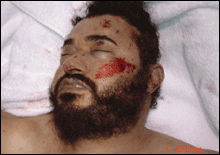
The dark hatred that fueled Zarqawi’s project won’t vanish with his death. If we’re lucky, though, Zarqawi’s replacement(s) won’t have his knack for setting Sunni against Shiite and killing and maiming en masse. Time will tell. In the meantime, we can all indulge in some dark enjoyment of the more absurd aspects of Zarqawi’s death, as newscasters everywhere struggle to correctly pronounce his name (gamely fought, Dolores Handy!) and US soldiers use photos that look to have been framed at a Sears Portrait Studio to prove he’s dead. A fittingly undignified end for a loathsome human.
 Related
:
Playing war, Fantasy World, Numbing carnage, More 
- Playing war
“I don’t think there’s a soul who likes that place,” Dan Cook tells me about 29 Palms when I walk over to his Dorchester apartment. Slideshow: “An-My Le: Small Wars” at the Rhode Island School of Design
- Fantasy World
The conclusion is inescapable: the position of the United States in the Middle East is far worse today than it was even two or three weeks ago.
- Numbing carnage
On the morning of March 8, viewers had their first sip of coffee to a grisly sight on the news shows: grainy video of roughly two-dozen dead Iraqis lined up in a makeshift morgue, many of them apparently bound and strangled.
- Camera bluff
Even as critics and moviegoers alike have scorned the surge of movies related to the War on Terror and Iraq, Nina Davenport has quietly been making illuminating, fair-minded, and entertaining films on these topics.
- Culture war games
Karen Finley sat at the edge of the stage of Emerson College’s Cutler Majestic Theatre last week and spoke about a woman who got off on war.
- Rethinking 9/11
The Phoenix decided to ask ten people prominent in a range of fields a question.
- Throw, don't tell
It is all too apparent that the Provincetown Police Department is in crisis.
- The brutal truth
The carnage is due to the aggression — the terror — of Hamas and Hezbollah, groups that at best are dedicated to the destruction of Israel and at worst want to kill as many Jews in the Middle East as they can.
- Statewide protests Saturday
In nearly 100 communities around Maine, citizens will protest the Iraq war on Saturday.
- Rueful reflections
March 19 marks the fifth anniversary of the start of our war in Iraq.
- Rebels with a cause
Unlike the war in Iraq, or the BU-biolab controversy, or immigrant rights, the fight to end genocide in Darfur — in which more than 300,000 have died, and 3.5 million are suffering violence and starvation — has brought out a cohesive movement of student activists.
- Less

Topics:
News Features
, Politics, U.S. Politics, George W. Bush, More
, Politics, U.S. Politics, George W. Bush, Political Policy, Armed Forces, Al Qaeda, Terrorism, War and Conflict, Saddam Hussein, Military and Defense Policy, Less
