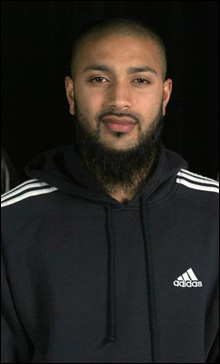
TRAPPED: Ruhel Ahmed’s life after Guantánamo hasn’t been pretty either. |
You’d think that after escaping the black hole of US detention camps at Guantánamo, life would be pretty much downhill. Not necessarily so for the so-called Tipton Three, a trio of Brits caught up in the invasion of Afghanistan and incarcerated as Al Qaeda suspects in 2001. Their experiences — up to their release and vindication three years later — are covered in Michael Winterbottom and Mat Whitecross’s docudrama The Road to Guantánamo, which opens Friday. What the film doesn’t cover, however, is what happened afterward. Like, when applying for a job, what do you put on your résumé? “It’s hard to find work because on your application form you have to write down what have you been doing for the past seven or eight years,” says former prisoner Ruhel Ahmed on the phone from his Tipton flat. “And so you’ve got a big gap and you have to write down exactly where you’ve been, and why you were detained. When an employer looks at the application form he thinks, ‘maybe he’s a terrorist.’ So you don’t get the job.”
And it’s not just potential employers. The authorities and media apparently still wonder if the Tipton Three are terrorists, even though they were cleared of all charges upon release.
“I’ll give you a quick example,” says Ahmed. “The FBI said, ‘if you ever travel to America, we won’t send you back to Guantánamo, but you will be arrested and you will be sent somewhere a lot worse.’ So Roadside Attractions, the distributors of the film, sent me a satellite device so we can do live satellite-linked interviews from my house [to promote the movie]. They sent that to me [but] it got stopped [in customs]. They’re not releasing it because it’s got my name and address on it. And now they’re phoning me and phoning [Roadside] and saying ‘why have you sent this?’ It’s just ridiculous, really. Obviously I’m being watched,” he says.
Matters only worsened on July 7, 2005, when terrorists bombed the London subway.
“It was the front page of the Sun. They said: ‘could it have been the Tipton Three?’ Which was absolutely ridiculous. Because we were shooting in Pakistan at the time with the directors.”
The irony is that before their horrible experience, the three mates were totally apolitical. That’s now changed.
“Since Guantánamo I have been a bit more interested in politics,” says Ahmed. “Prior to that I wasn’t. I think all politicians are just liars. They deceive the people into doing things that they want to really do. If I could advise Americans, I would tell them to stand up and protest against Bush and his administration because the American people are the people who can make a difference in the world.”
