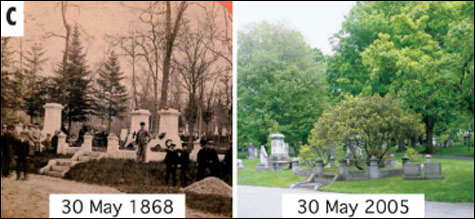
EARLY BLOOMERS Mt. Auburn Cemetery lush on Memorial Day 2005 (right) but bare on May 30, 137 years before (left). |
When we think of global warming, we picture glaciers melting, sunbathing polar bears, and The Day After Tomorrow. But Boston University professor Richard Primack and doctoral student Abraham Miller-Rushing have been asking, what does climate change mean for the flora and fauna in our own backyards?
To answer that question, Primack and Miller-Rushing are assembling an archive of historical observations — largely from scratch — and they need your help as they piece together unusual data, from bird-watchers’ notes and archival photos to naturalists’ diaries.
The project started in 2002, when Primack dug through the Arnold Arboretum’s files of plant clippings, which date as far back as the 1880s. Many of the Arnold’s specimens were cut from trees, shrubs, and vines still growing at the Jamaica Plain park. So the following summer, they recorded when 229 of those plants bloomed. Meetings with botanical clubs and birders led them to Concord storekeeper Alfred Hosmer’s notes on the flowering of 700 Concord plants over a 15-year period beginning in 1888. A pal of Primack’s pointed them to a New Hampshire expert on Henry David Thoreau’s scientific writings, Brad Dean, who gave them data he’d culled from Thoreau’s diaries of the flowering dates between 1852 and 1857 for some 500 Concord species. Using these records, Primack and Miller-Rushing then monitored living cousins of the plants in Concord from 2003 to 2006.
The inconvenient truth? Early-spring-blooming plants — marsh marigolds, columbines, blueberries, shadbush, huckleberries — are flowering in Concord eight days earlier, on average, than when Thoreau stopped to smell the flowers, and four days earlier than Hosmer’s records show.
The pair found “an extremely strong relationship” between flowering times and temperatures, with an overall shift toward earlier blooming dates, as average Boston temperatures increased by three degrees Fahrenheit over the past century. (About one degree of that temperature increase is attributed to global warming, the rest to heat retention due to increasing urbanization, according to Primack and Miller-Rushing.)
Many birds are migrating earlier as well. That conclusion is based on sightings at Mount Auburn Cemetery in Cambridge and the Manomet Center for Conservation Sciences, and observations recorded by a Middleborough farmer over four decades. Wood ducks, for instance, arrive as much as six weeks earlier than they did 37 years ago. Birds, bugs, and plants have intricate food-chain relationships. As rising temperatures cause critters and plants to change their timing, these relationships are “going to be more and more jumbled up,” Miller-Rushing says.
“Global warming is not something that’s happening far away. It’s happening here. It will be affecting many aspects of our lives,” Primack says. Woodland wildflowers like swamp violets, marsh marigolds, and false hellebore will likely disappear from Massachusetts. And the region may grow too warm for spruce trees. Warmer winters are already hurting seasonal tourism, too. Lyme disease is a growing threat because more ticks survive mild winters. Plus, a bevy of other threats, including rising sea levels, lies in store for us.
Primack and Miller-Rushing are now looking for old diaries, journals, and dated photographs that record flowers, butterflies, dragonflies, migratory birds, fish — anything that might help them put together a timeline of local nature changes. Remember, knowledge is power.
Primack and Miller-Rushing will give a free talk about their work on April 25 at 6 pm, at the MIT Museum, 265 Mass Ave, Cambridge.
On the Web
Primack and Miller-Rushing's research: http://people.bu.edu/primack/research.html
