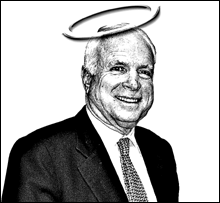
 WEST LEBANON, NH — John McCain’s transition from maverick to mainstream politician hasn’t played well with the national press. Washington Post columnist E.J. Dionne, for one, thinks the Arizona senator is “less interesting and more conventional than he used to be,” and Daily Show host Jon Stewart wondered aloud, “Has the Straight-Talk Express been rerouted through Bullshit Town?”
But here in the Granite State, where McCain spooked George W. Bush with a 19-point win in the 2000 presidential primary, his image hasn’t lost any luster. It’s lunchtime on a recent Saturday, and a crowd of McCain admirers are jammed into the local Borders, eager to meet their political idol and nab a signed copy of his latest moral-ed opus, Character Is Destiny: Inspiring Stories Every Young Person Should Know and Every Adult Should Remember (Random House). As they stand in line, inching toward the dais where McCain sits, the assembled McCainiacs look a bit like supplicants waiting to meet the pope. There’s a nervous energy in the air. When the moment of reckoning comes, grown women gulp for air and tough-looking men get misty-eyed.
McCain adroitly puts his fans at ease. His smile is quick, his gaze intent, and each one-minute exchange looks more like a genuine conversation than a political transaction. As the satisfied customers say good-bye, they hew closely to a few familiar themes: it’s an honor, sir. Supported you in 2000. Next time!
Among those waiting: Amanda Holzer, a college student who drove three and a half hours from upstate New York for a chance to shake McCain’s hand. “I want to be a volunteer,” Holzer says of the campaign that she and everyone else in the room assumes is coming. “I want to do everything. He’s my hero in politics.”
Hit or myth
All that fervor on the ground hasn’t tempered the anti-McCain backlash kicking up in the press. Its immediate cause was the senator’s decision — six years after calling fundamentalists Jerry Falwell and Pat Robertson “agents of intolerance” — to give the commencement address at Falwell’s Liberty University this May. The lesson seemed clear: now that he’s the 2008 Republican front-runner, McCain can’t be the same nail-spitting independent he used to be. Instead, he’s got to measure his words, play to the base, make nice with old enemies — in short, be an ordinary politician. This hasn’t diminished McCain’s celebrity — he’s still a fixture on the political talk-show circuit — but he’s no longer treated with kid gloves.
