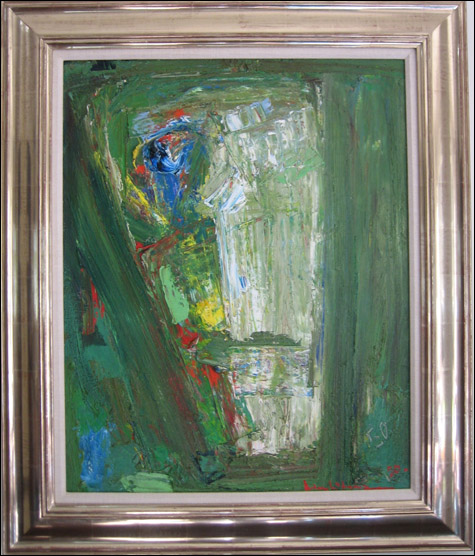
IMAGE IN GREEN: At his best, Hofmann is exquisitely sensitive to the way color taps directly into your heart. |
| “Hans Hofmann: Circa 1950” | Rose Art Museum, Brandeis University, 415 South St, Waltham | Through April 5 |
A long time ago (say 70 years), in a galaxy far, far away (New York), a tired band of rebels ached to be the Next Big Thing. These artists had their eyes on the hot stuff coming out of Paris — Cubism, Dada, Surrealism — while the Paris artists themselves were coming out of Paris, fleeing Hitler. With the European avant-garde taking refuge in the Big Apple, and democratic Europe fighting for its survival, the New York art gang kept right on painting.
One of those European expats was Hans Hofmann, a German who had studied in Paris, hung out with Picasso and Matisse, and taken Picasso's Cubist compositions and Matisse's feel for color to heart. He came to the US to teach in 1930; Hitler's moves persuaded him to settle in New York two years later. There, and in Provincetown, he opened his own schools, where he taught a generation of artists that included Larry Rivers, Red Grooms, Joan Mitchell, Ray Eames, and Allan Kaprow.

Hofmann became known as a thinker and a theorist of abstract painting. He explained how overlapping shapes and suggestions of shadows could create a dynamic "push-pull" tension between the flatness of the canvas and illusions of depth. He spoke of the emotional jolt colors could pack. He believed in improvisation. Via his teaching and writing and public speaking, his ideas went viral. They became central to the Next Big Thing, which came out of New York in the wake of World War II. It became known variously as Action Painting and Abstract Expressionism.
The new stars — Jackson Pollock, Willem de Kooning, Mark Rothko, Franz Kline, Barnett Newman — were men in their late 30s and 40s who made big bold macho paintings with tangles of slashing lines or great fields of color. Hofmann, a generation older, kept painting, but his ideas, the theoretical underpinnings for many artists' experiments in abstraction, overshadowed his abstract canvases. The sharp, scholarly exhibit "Hans Hofmann: Circa 1950" arrives at Brandeis's Rose Art Museum still mulling over whether his painting was as important as his thinking. Curators Michael Rush, the Rose's director, and Catherine Morris, an independent operator, say yes.
Abstract Expressionism was in the midst of its big moment in 1950 — in August 1949, Life magazine asked whether Jackson Pollock was "the greatest living painter in the United States." Hofmann turned 70 that year, and he was about halfway through his great late period, which ran from, say, 1940 until his death in 1966.
Rush and Morris bore into Hofmann's work from 1950 (with a few works from 1949 thrown in for good measure). The heart of the 41 paintings and drawings in the show is a suite of nine seven-foot-tall vertical panels that he painted in 1950 as sketches for murals for a proposed church in Chimbote, Peru. The project never came to fruition. Brandeis is billing this exhibit as the first time the panels have appeared in an American museum — after they were exhibited in a New York gallery that fall, it seems they went to Spain for half a century.
The mural studies are hung on metal fencing suspended along the middle of the gallery. Sketch — Chimbote Mosaic Cross is a blue cross on a hot-yellow background with a red-pepper shadow. Circles or orbs float at the top of the cross and at the end of its left arm. Study for Mosaic Cross has a stout red cross at the right and on the left a red-and-yellow orb that radiates bands of color. Atop a putrid-green background, Chimbote Mural seems to depict a jagged, abstracted figure (a crucified Christ?) with what might be an all-seeing eye of God as its head. Sketches included here suggest that the mural compositions grew out of increasingly fractured and abstracted renderings of what might be a bird.
In these paintings, Hofmann layers vivid colors, scraping and scrubbing them, as well as slapping on lush, thick glops. Other paintings in the group are more schematic — prickly doodly lines, layered arcs and parallelograms, kissing geometric forms — in thinly applied paint.
Works falling outside this series hang on the surrounding gallery walls, suggesting rhymes and repetitions Hofmann was exploring. Provincetown seems to pick up the geometric motifs of the murals, this time stacking them in two groups of circles, tangles, and cockeyed rectangles. Hofmann, as he often does, has two main compositional modes: big and little. Major figures, shapes, heavy outlines are accented by little dots and squiggles.
And note the ravishing colors — among the Abstract Expressionists, only Rothko was his equal as a colorist. Hofmann favors the basic hues of a kid's paintbox, but at his best he's exquisitely sensitive to their combinations, to the way color taps directly into your heart.
