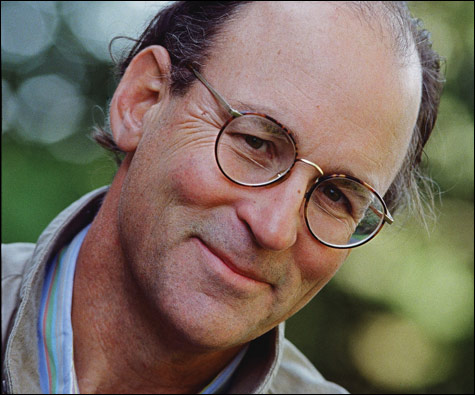
Photo: Gabriel Amadeus Cooney
STARTING A NEW CHAPTER? Kidder goes global with his documentary style. |
| Strength in What Remains: A Journey of Remembrance and Forgiveness | By Tracy Kidder | Random House | 277 pages | $26 |
As Tracy Kidder’s immersive journalism matures — his latest book recounts his travels through genocidal East Africa — he becomes more visible. He featured significantly in his debut book, The Road to Yuba City (1974), which chronicled the murders of migrant farm workers in California. But he so regretted putting himself in the story that in 1981 he bought the rights back to prevent future republication, and he declines to list Yuba City on his books’ “Also by this author” pages. He began to disappear from the narrative in The Soul of a New Machine (1981), which won the 1982 Pulitzer for general non-fiction. By House (1985), he had perfected the art of invisibility. A passage describes the view from the ground, then quotes a builder on the need for everyone who goes up a ladder to carry a box of shingles, and then — with no acknowledgment that Kidder himself climbed and carried — moves to a scene on the roof.He stayed hidden through the rest of what became a four-book-deep study of his community in Western Massachusetts: Among Schoolchildren (1989), Old Friends (1993), and Home Town (1999). But he allowed himself back in Mountains Beyond Mountains, the 2003 volume that garnered lots of publicity for the book’s subject, Dr. Paul Farmer, and Farmer’s effort to bring health care to rural Haiti. After a reflective Vietnam War memoir, My Detachment, in 2005, Kidder releases Strength in What Remains: A Journey of Remembrance and Forgiveness, the second in what might become a series of intensely personal global social-issues investigations.

Strength’s prologue shows Kidder and Deo, the book’s main subject, driving through Burundi, returning to Deo’s home village more than a decade after his escape to America from the Hutu-Tutsi massacres of 1993 and 1994. The first section covers Deo’s youth, the civil war’s interruption of his studies to become a doctor, his flight through the wilderness, and how he rebuilt his life starting as a poor refugee in New York City.
Kidder’s gift is in the way he merges eagle-eye on-the-spot reporting with probing after-the-fact interviews, making us not just observers but privy to people’s innermost thoughts. In his previous books, we were left to imagine the exhausting work of assembling all these details. But in Strength’s second section, he gives a master class in interviewing, offering his own thoughts, as well. His devotion to his work and his compassion for those he writes about is most poignant when he confesses that he feared he was asking Deo questions that would “traumatize him all over again. On several occasions, I offered to stop my search for his story and let his memories die, if they would. Once or twice, I hoped he would accept my offer. But he always declined.”
We accompany Kidder and Deo as they travel to Burundi, retrace Deo’s route to safety, and also launch a Burundi branch of the medical initiative Kidder described in Mountains. We research with Kidder the baseless “distinctions” between “Hutus” and “Tutsis” that were so central to the mass slaughter. We, too, feel terror when he and Deo explore the now-vacant hospital where the massacre began for Deo, and from which Deo fled into the wild. “Up until now I hadn’t fully understood . . . that even his most lurid dreams weren’t weirder or more frightening than what inspired them. He didn’t wake up from his nightmares thankful they weren’t real.”
TRACY KIDDER | Brattle Theatre, 40 Brattle St, Cambridge | September 22 at 6 pm | $5 | Available at Harvard Book Store, 1256 Mass Ave, Cambridge orwww.harvard.com | Porter Square Books, Porter Square Shopping Center, Cambridge | October 8 at 7 pm | 617.491.2220 orwww.portersquarebooks.com
