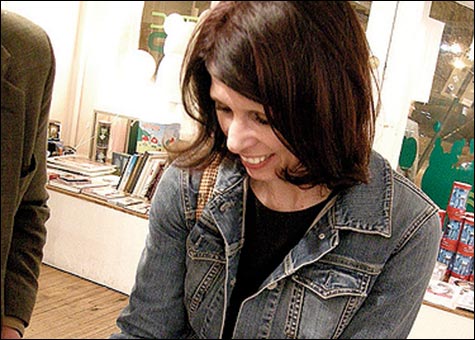
BOOKED: Reading, Brottman says, has become “a new panacea that conquers everything.” |
| The Solitary Vice: Against Reading | By Mikita Brottman | Counterpoint | 240 pages | $14.95 |
Freelance writers are often the recipient of unusual opportunities. Recently I had the chance to interview a former member of the Gambino crime family who, during his 10 years in prison, discovered both Orthodox Judaism and Marcel Proust and has written a memoir about how this changed his life. One reason I turned it down was that it seemed to play into the most persistent fantasy of the literate: reading makes you a better person.In The Solitary Vice: Against Reading, Mikita Brottman says no to that supposition, not in thunder but in the voice of common sense. Brottman, a professor of Language, Literature, and Culture at the Maryland Institute College of Art, has written a book that’s part memoir of an English childhood spent willingly isolated among books and part polemic attacking the shibboleths that currently surround reading.
It is not an argument against books or against reading but an attempt to be clear about the act. Over the phone from Baltimore, Brottman tells me she got “disgusted” with the Reading Is Fundamental campaigns and their kind. “Reading has become an unassailable virtue. There are more kids who were like me than one would suspect whom reading has kind of separated from their family, led them to be dissatisfied with the world outside of books, given them a vocabulary they can’t use.” Reading, she says, has become “a new panacea that conquers everything.”
Part of what Brottman is reacting against here is the sweeping claims that deify reading without taking into account its reality. She mentions a particularly wrongheaded New York Times op-ed from 2004 in which Andrew Solomon (The Noonday Demon) banged on that old saw beloved of reading groupies: Literary Culture Is Active, Visual Culture Is Passive.
Nonsense, says Brottman. “Literacy is so important to our culture because there is no real outlet for people to have different kinds of intelligence.” In other words, literacy has become the only way to measure intelligence. “I have art students who grasp pretty complex ideas but can’t put them into words. If someone is a great video-game designer or a great artist or a great musician, when it comes to speaking about it, if they aren’t articulate, they’re seen as freaks.”
She continues, “People are always talking about the split between visuals and literature.” In The Solitary Vice, she makes what seems like an obvious point except that it’s consistently ignored by proponents of literature: “To make the case that ‘visuals’ have triumphed over ‘text,’ you have to ignore the fact that text is also a visual medium.” And she goes on to say that if we include digital media, then the case that people are reading less falls apart.
