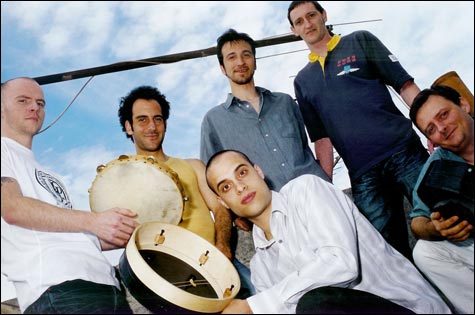
TANT DEMAN: “Maybe tomorrow” is the title of the new album, but any day would be a good time to catch this Marseille sextet. |
“Bon soir!” someone from the audience shouted as the six members of Lo Còr de la Plana took the Somerville Theatre stage last Friday. “Bono sero!” answered Lo Còr frontguy Manu Théron, explaining that though they’re from Marseille (specifically the city’s bohemian “La Plaine” district, hence their name, “The Heart of La Plaine”), they sing not in French but in Occitan (a/k/a Provençal), the old (and to some degree modern) language of southern France, the language of the troubadours, a rich, compact, expressive language that’s the heart (or perhaps the stomach) to French’s head. What kind of audience wants to hear six guys sing mediæval harmony while accompanying themselves on bendir (a North African frame drum, like an Irish bodhrán) and tamburello (a tambourine, with and without membrane)? Not a large one, it turned out: the Somerville’s balcony was closed off, and the downstairs was hardly half full.
If you were there, however, you got your money’s worth and then some. Dressed in everyday dark shirts and jeans, now spreading across the stage, now closing up into a circle, with Théron initiating each number by pulling a tuning fork out of his pocket, they served up a musical bouillabaisse, the tight harmonies (complete with vocal bourdon, or drone) coupled to dance rhythms from Arab and black Africa and the Caribbean as well as France. Stage right, Rodin Kaufmann and Benjamin Novarino-Giana anchored the proceedings with foot stomping and hand clapping; stage left there was Denis Sampieri and Sébastien Spessa on bendir and Manuel Barthélémy on tamburello; Théron, with the big bendir, held the foreground, not exactly hip-hop but certainly hip. The complex polyphony rendered the lyrics incomprehensible, but the situation wouldn’t have been much different if they’d been singing in French, or even English. Théron offered brief explanations before most of the numbers, equal parts politics and humor, identifying Marseille as the “northernmost city in Africa” and excoriating France’s restrictive immigration policies. Lo Còr’s performance, Avignon meets Algiers, was the argument to which there could be no rebuttal.

The opening “Nau gojatas” (“Nine Girls”), a seemingly simple countdown of successively fewer girls looking for boys to dance with, built to a tribal intensity of drum banging. A war cry from the audience embellished “Tant deman” (“Maybe Tomorrow”), which is what you say to your mother-in-law, or the Devil, when he/she shows up at the wrong time (as if there were a right time). “Feniant e gromand” (“Lazy and Greedy”) kicked off with an a cappella quote from the beginning of Richard Strauss’s Also sprach Zarathustra (a/k/a the monolith theme from Stanley Kubrick’s 2001). “Condés” (“Cops”), based on a true story from Strasbourg, found the nine policemen, like the “nau gojatas,” disappearing one by one, as the cops, having lobbied for bigger and better guns, manage to shoot one another. “Jorns de mai” (“Days of May”) is about what boys and girls do in the title month, but you wouldn’t have known that from the immigration politics of Théron’s introduction. Most of the material was from their second album (the first, Es lo titre, is sold out, but you can get MP3s), Tant deman, though there was one new song, “La filha de vesin” (“The Neighbor’s Daughter”), in the main set, and another, identified as “Freedom,” as the second encore. The vibe throughout was intensely masculine but not unfeminine: laughter in the heart, dancing in the feet, a wry and almost cynical smile on the face.
