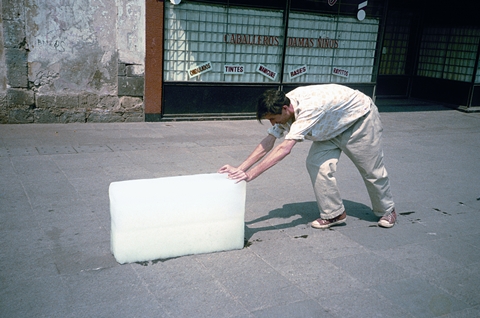
PARADOX OF PRAXIS 1 In one project, Alÿs pushed and kicked a block of ice through Mexico City. |
It feels a bit like the art-world version of some twins-separated-at-birth Disney comedy: one artist born in Mexico who lives in Belgium, and one born in Belgium who lives in Mexico.At the Institute of Contemporary Art, we have "Nobody Needs To Know the Price of Your Saab," a show of sculpture by Gabriel Kuri, who was born in Mexico City in 1970 and currently splits his time between there and Brussels. Meanwhile, Wellesley College's Davis Museum is presenting "The Moment Where Sculpture Happens," which surveys 12 videos, photos, and paintings by Francis Alÿs. (Consider it an appetizer for the Alÿs retrospective coming to New York's Museum of Modern Art in May.) He was born in Antwerp in 1959, studied architecture, and moved to Mexico City around 1987 to work on aqueducts. At the Salón de los Aztecas café, a nexus of the city's art community, he met curators and artists including Gabriel Orozco and Abraham Cruzvillegas.
From around '87 to '92, Orozco, who was then living in Mexico City but is now based in New York, invited artists — including Cruzvillegas, Kuri, Damián Ortega, and Dr. Lakra — over to his place for weekly "Friday Workshops" of beer and talk. All of them have gone on to international art careers, and the ICA has offered an in-depth look at the last three via solo shows over the past 18 months. They follow in the footsteps of Marcel Duchamp and Richard Tuttle in their sculpture (except for Lakra, who makes tattoo drawings) by highlighting found, everyday objects in oddball assemblages.
At the ICA, Kuri's Overlapping statistics(blind olives eyelid) (2007) is a pile of plywood, roofing insulation, a jar of olives, a can of soda, and a tissue box propped one atop the next like, perhaps, a 3D graph. Elsewhere, a bowl holds avocados wrapped in a reprints of 1969 newspapers reporting Neil Armstrong's walk on the Moon. Kuri's weirdo absurdity peaks with his 1998 sculpture of a large pork rind (actually cast fiberglass), the kind familiar to patrons of Latino groceries, embossed with the words "Doy fé" (a legal phrase meaning "I attest") and displayed in a deli case.
Alÿs's work has been shown with the Orozco gang's in surveys of contemporary art from Mexico, but he seems not to have been a real part of that crowd. He displays a bit of their wit and focus on the everyday in The Moment Where Sculpture Happens, a photo of the artist stepping in gum, but his sensibility is different.
The Davis show, which was organized by curator Jay Oles, includes two slide projectors that shine side-by-side photographs of a bicyclist hauling two mattresses, a fellow pushing a hot-dog cart, and men carrying ladders or boxes or bundles of Mexican flags through Mexican streets. Through Alÿs's eyes, they become found performances.
His related 1997 video Paradox of Praxis 1 (Sometimes Doing Something Leads to Nothing) is a five-minute summary (thank goodness) of nine hours he spent pushing and kicking a tombstone-sized block of ice along the sidewalks and streets of Mexico City until it turned into a puddle. This is a winking nod toward Minimalist sculpture, and Mexican labor, but mostly it's alluringly strange and goofy and a bit pretentious and kind of magical.
