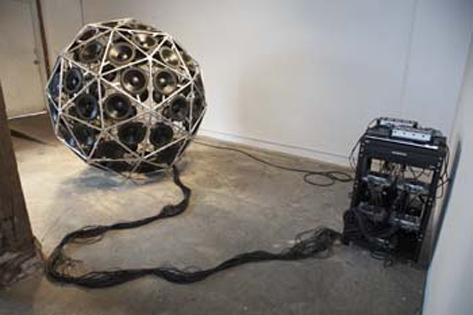
LOOKS BETTER IN THE CATALOG Sam van Aken's "Thumper," from 2007. |
Two years ago, I wrote about the '07 Biennial's senses of scope and adventure, though it was also sprawling and inconsistent, as a comforting mirror image of the Maine art world's idiosyncratic inclusiveness. I eagerly anticipated the tighter focus of this year's exhibition as our state's calling card for a worldwide contemporary dialogue. Although no one piece in this spartan biennial is lacking in value, the collective effect is one destined to get lost in the Rolodex. If I didn't know better what Maine artists have to offer, I'd be asking, "Wait — is | 2009 BIENNIAL | through June 7 | at Portland Museum of Art, 7 Congress Square, Portland | 207.775.6148 |
that all you've got?"The jurors, Elizabeth Burke of New York's long-standing Clementine Gallery, video art pioneer Dan Graham, and Mass MoCA's Denise Markonish, developed a streamlined vision as they confronted a record number of submissions and creatively culled them to a severe 17 artists. There are several impressive large-scale works where magnificence within the museum space is paramount and presence overwhelms previous biennials' occupation of accounting. Unfortunately, many of the works are dwarfed by what should be a savvy sea change heralding what is expected to be a bold new chapter in the PMA's history.
Ethan Hayes-Chute's "Hermitage," a full-scale construction of a cabin in the woods, seizes the viewer upon entry into the museum's large lobby. Coaxed into a voyeuristic fascination, you peruse all the minute details of a life out of context. Every object in every corner has the mysterious aura of story. You leave the immersion eerily affected, but marveling at the hand that created it.

Wade Kavanaugh outdoes himself with the formidable piece that begins the show. The viewer is ushered down a narrow hallway created by a massive wall laid out in compressed-sheetrock bricks. By the time you turn the tight corner, the wall has reached the ceiling to create a spatial vantage point where the only focus is the material. As you are led into the next gallery, the space reopens to reveal a cascading sea of bricks, filling the entire first gallery room. The right angles become choppy waves as the singular becomes mass. All viewpoints reveal new relationships to the space. In a masterful stroke, Kavanaugh transmutes our expectations by manipulating our perceptions.
A. Jacob Galle's ambitious video work, "Spring Fever/Pilgrimage," is a lengthy video narrative that is worth the 20 minutes. Cinema vérité with fixed camera is the rule. The protagonist puts his laundry in the washer, packs his bag with the results, and begins a long hike. Hard edits between landscapes establish an austere sierra through which the artist diligently trudges, slowing the rapid digital medium to nature's crawl. You begin to empathize with the sense of accomplishment that accompanies the summit. Galle performs his appointed task, slowing to a godly pace not of the instantaneous miracle, but of our miraculously small place in the world.
Sean Foley's "Menace" is a Frankenstein installation of two traditional paintings and two 3-D groupings of shapes, flung far apart across the architecture of the gallery, all tied together with a snappy wall painting of winding red ribbons. Foley has created a world of building blocks out of his own body of work, interchangeable and adaptable, so the disappointment here comes not from the individual elements, but their site-specific assembly. The wall painting fades prematurely and fails to support the two canvases, which are lost in the morass.
Sam van Aken's geodesic sound sculpture, 2007's "Thumper," seems to glow with an aura of knowing play. The only problem is, "Thumper" looks better in the catalog. The same goes for Andy Rosen's "Let's not and say we did," in which a pleasurably vile woodland scene sits awkwardly among its biennial cohorts. These pieces are far more gripping when photographed than when squeezed into the survey. The biggest crime in this regard is committed against the often-impeccable Dozier Bell, whose small works run deep and reward your attention, but the effect in this biennial context is much like trying to read a poem aloud to an audience watching an action movie.
This fault does not necessarily fall in the lap of the museum, which is playing the hand dealt to it by jurors. In fact, coming down on the biennial seems more a matter of chalking it up to growing pains than dishing out blame. The 2009 Portland Biennial is exciting and engaging and worth the time, if a bit in an awkward phase. If you're looking for exciting contemporary work, you'll get what you came for. If you're looking to stand by a show as an accurate sampling of what Maine artists have to offer, you better start looking elsewhere.
Ian Paige can be reached at ianpaige@gmail.com.
