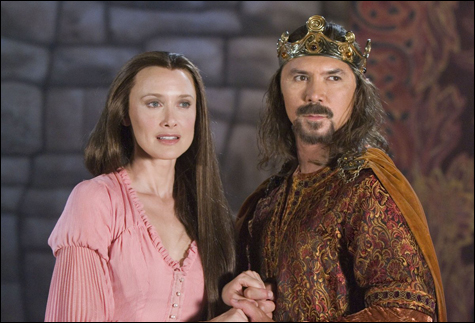
POWER COUPLE: de Benedet and Phillips. |
You’ve got to hand it to the Obama team for going that extra step. What awesome organizing ability, to arrange for the musical Camelot to open at the Providence Performing Arts Center (through March 9) on the night of his dashed hopes for a Rhode Island primary election victory.
Yes, a case can be made that the lessons many take away from the legend of the Knights of the Round Table are hopelessly naïve. But, of course, no less a hard-bitten political realist than JFK, along with wife Jackie, adopted the 1960 Lerner and Loewe musical as their unabashed inspiration. For the moment we will forget any disparity between the Round Table’s “Might for Right” ethos and the Bay of Pigs invasion.
But seriously. There is a charming frankness and honesty to this portrayal of the way the world works. Based on T.H. White’s wise and wonderful novel The Once and Future King, the tale is an account of how idealism develops, personally and politically. But it doesn’t neglect to remind us how towering ideals can crumble when creatures as flawed as we human beings have constructed them. And it does so without giving much ammunition to cynics: all the tragic flaws depicted here are falls from greatness.
Look how easy it is to identify with these characters, if you have any spark of pride that could be fanned into hubris. The story is framed by King Arthur (Lou Diamond Phillips) thinking about his mistakes as he wanders his camp on the eve of battle, a fight resulting from his weakness as a kind leader and a trusting husband.
One of the wonderful things about this musical is how precisely the songs amplify feelings at crucial moments, feelings that would otherwise only be mentioned in passing. When Arthur is baffled at the ways of Guenevere (Rachel de Benedet), “How to Handle a Woman” doesn’t come across as instructional exposition but rather as heartfelt (hint: love her). Similarly, “I Wonder What the King is Doing Tonight?” conveys their being somewhat bored with each other, setting us up for her falling for Lancelot.
Although Phillips lacks the solid physical presence, and the booming baritone, of Richard Burton, who originated the role, he’s quite right as King Arthur. His singing voice is fine, and he can raise himself up to royal stature well enough, but his real coup is in providing a boyish vulnerability. Arthur’s nickname has been Wart, after all, from the time he was a humble squire who pulled the sword out of the stone to earn his right to become king. Phillips still has in him the buoyant Ritchie Valens of 20 years ago in La Bamba.
He has a worthy Guenevere in the lovely and crystal-voiced de Benedet. She easily handles the diverse personality range of his queen, from the spirited girl he meets in the woods when she flees an arranged marriage with him, to the woman with the regal bearing eight years later, to the tormented wife who nevertheless retains her poise when she falls in love with his best friend, Lancelot.
As the brash Lance¬lot, that marvelous amalgam of ego and earnestness, Matt Bogart strikes all the right notes. He stresses the sincerity of the French knight’s conviction that he is all but perfect rather than overplaying the humor, but that interpretation works well.
Camelot is a smorgasbord of greatest musical hits. They range in tone from the playful “Lusty Month of May,” sung by the ensemble as they cavort in spring, to the touching “If Ever I Would Leave You,” sung by Lancelot in the depths of his hopeless love for Guenevere. For the droll “Fie On Goodness,” rent the 1967 movie. Its thematic place is fulfilled by “The Seven Deadly Virtues,” sung by Mordred (Shannon Stoeke), Arthur’s bastard son of a witch who seduced him as a youth.
This revival production attempts to faithfully resuscitate the 1960 Broadway version, to the point that a director is not credited in the program, which cites the “Original Broadway Production Staged by Moss Hart.” The result is that the spirit of this wonderful piece of Broadway musical history shines brightly as it passes through Providence.
