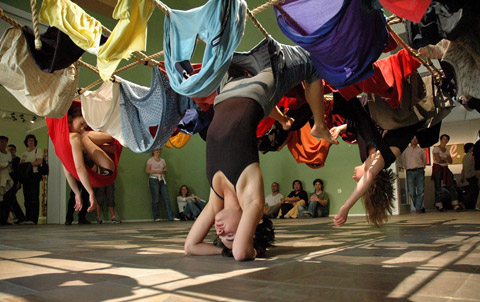
FLOOR OF THE FOREST Trisha Brown’s 1970 piece deploys the draftsman’s grid as an armature for dance. |
When the Institute of Contemporary Art hired Helen Molesworth away from Harvard in 2010, it seemed like the ICA's new chief curator might fill a big gap at the institution: the ability to put together strong theme exhibits. The ICA's strength in recent years has been blockbuster solo surveys — Shepard Fairey, Anish Kapoor, Tara Donovan — but its shows built around ideas or trends have been either baggy catchalls (see: 2006's "Super Vision") or imports from other institutions.
>> SLIDESHOW: 'Dance/Draw' at the ICA <<
Molesworth begins to fulfill that promise with "Dance/Draw" (at the ICA through January 16), a survey of 50 artists from the last five decades that looks at how drawing became a sort of performance, lines became sculptures, and choreographers began to think of dance as vectors and geometry.
The heart of the show is the severe, minimalist asceticism of Trisha Brown, Yvonne Rainer, and Lucinda Childs — all part of what became known as the Judson Dance Theater. Based at the Greenwich Village Judson Memorial Church, the group emerged from workshops Robert Dunn taught, beginning in 1960, on John Cage's ideas of composing by coin tosses and other "chance operations." They composed art out of ordinary "pedestrian movement," lists of basic tasks, geometry (all hail the grid!), measuring (see: Bruce Nauman's 1966 Neon Templates of the Left Half of My Body Taken at Ten-Inch Intervals), and a sciencey focus on exploratory process rather than finished product. For example, in the ICA galleries on Thursdays, Saturdays, and Sundays, dancers perform Brown's 1970 Floor of the Forest on a grid of ropes and clothing suspended five feet above the floor on a steel armature. They climb across the web, slip into the sweaters and pants, dangle down, wriggle out, and repeat. The Judson gang spawned a lot of funny business performed with deadly seriousness.
For Molesworth, this becomes a traditional Modernist story of the triumph of formalism. Dance is broken down into elemental actions like the simple arm movements, spins, and leg sweeps in Rainer's 1978 Trio A. Drawings become lines floating in space in Ruth Asawa's early-'60s crocheted wire chains of dangling bulb-shaped baskets, Faith Wilding's '72 crocheted spider web, and Fred Sandback's '82 installation that stretches yarn from floor to ceiling to delineate the edges of invisible rectangles. Drawing merges with dance in Janine Antoni's 1996 video performance Loving Care, in which she uses her long hair to mop a floor with "Loving Care" hair dye.
The show crackles with ideas, but Molesworth offers a narrow definition of the intersection of dancing and drawing, devoid of kinetic art, animation, and digital graphics. Absent is a whole line of colorful, emotional, narrative, social, ecstatic dance and drawing epitomized by Bread and Puppet Theater, which was founded by Peter Schumann after he dropped out of the Dunn workshops. Instead, nearly everything here is parsimoniously black and white. Where's the color? Where's the fun?
>> SLIDESHOW: 'Dance/Draw' at the ICA <<
