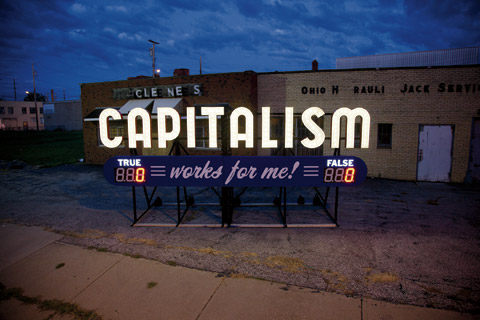
CAPITALISM WORKS FOR ME! Steve Lambert's 20-foot-long sign reading allows you to vote "true" or "false" and displays the tally. |
"Contemporary and Boston, Opposites No Longer," a New York Times headline announced in October. It was another alert that $1 billion invested in expanding and endowing local museums over the past decade is paying off in a newly vigorous Boston contemporary art scene.Although this added exhibition capacity is great for viewers, art made here remains relegated to the sidelines. For example, the Museum of Fine Arts' new contemporary art wing features big shots upstairs, while locals are segregated out in a downstairs hall alongside art by Boston youth.
So the deCordova Sculpture Park and Museum's Biennial (51 Sandy Pond Road, Lincoln, through April 22) arrives as a necessary corrective. Dina Deitsch of deCordova and Abigail Ross Goodman, who owned Boston's now-closed Rotenberg Gallery, provide a snapshot of art here now by assembling 23 artists and collectives from Massachusetts, Rhode Island, Vermont, and New Hampshire.
Outside the museum entrance stands Jamaica Plain artist Steve Lambert's 20-foot-long, retro light-up sign reading "Capitalism works for me!" A pedestal allows you to vote "true" or "false" with the tally displayed on the sign. It deploys democratic surveying, wisecracking, and American marketing pizzazz to ask one of the big, societal questions lurking amidst our not-so-great depression.
Boston duo Alexi Antoniadis and Nico Stone present the ruins of crappy, strip mall America: a broken lamppost folded around a bottle, a row of institutional doors turned on its side, a broken leg from a park bench. The installation is too nice or baggy or something, sapping some of the work's end-of-the-world jolt. But notice that the pieces are actually particleboard and plasticscast, carved, and painted to astonishingly mimic metal and concrete. And spot the penny standing on end at the bottom of a broken abstract sculpture: a tiny, melancholy, urban miracle.
Chris Taylor of Providence expertly fashions glass into imitations of Styrofoam cups. Boston painter Joe Wardwell's Elaborate Plans features the title (quoted from the Doors' song "The End") atop a vision of desert plains and snowy mountains, combining ecstatic 19th century American landscape painting and TV's Bob Ross to question American machismo and Manifest Destiny. The Biennial also includes Lauren Kalman's jewelry that imitates sores and Taylor Davis's finely crafted minimalist sculptural absurdities.
It's a polished, professional, and handsomely crafted show. The Biennial is sharper than the ICA's Foster Prize shows (deCordova is better at finding strong, original New England art, whereas the ICA favors local art that looks like it's from Away) or the soulless last Whitney Biennial, but on the whole there's not enough moxie.
Across a wall in the main gallery, Joe Zane of Cambridge has installed mirrored letters saying This is not the Biennial I was hoping for. It's an acid, self-mocking put-down of the whole enterprise that also seems to speak about the longing not to be stuck in the New England art ghetto, to get featured in one of the big national or international biennials.
But some of the freshest art thinking going these days is regional, like the Pennsylvania Academy of Fine Arts' flyover country survey "Here" and the dozens of California venues surveying the history of Los Angeles art as part of the Getty's "Pacific Standard Time." The art world is dominated by a groupthink born of curators all drawing from the same pool of artists in Artforum, New York galleries, the Miami art fairs, and a few international biennials. We need shows like the deCordova Biennial that explore our often-overlooked territory. ^
