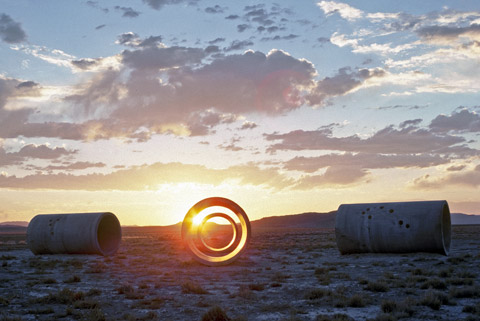
SUN TUNNELS Holt's art aims to retrain our eyes to better experience the world around us. |
When Nancy Holt first traveled west in 1968, where she would later create her most iconic work, she landed in the desert at the Las Vegas airport. "The landscape, the openness, was similar to the spaciousness I felt within," she recalls in the catalog for "Sightlines," which was organized by Alena J. Williams for Columbia University and is now on view at the Tufts University Art Gallery (40 Talbot Ave, Medford, through April 1).Holt is part explorer, part surveyor, part hippie/New Age dreamer. And this thorough survey of her art from 1966 to '80 shows her finding her way to becoming one of the pioneers of the "Land Art" or "Earthworks" movement.
She was born in Worcester, grew up in New Jersey, studied at Tufts (class of 1960), and settled in New York, where she lived until moving to Galisteo, New Mexico, in 1995. Her art aims to retrain our eyes to better experience the world around us. In 1971 and '72, she set up "locators" — metal pipes set up on stands like telescopes without lenses — to focus visitors' views in her studio, a gallery, and a grassy Montana field. Similarly, she bored a 66-foot-long pipe through a sand dune at Narragansett Beach in Rhode Island in 1972. Look through to grassy dunes or sparkling beach.
For her best known work, Sun Tunnels (1973-76), she arrayed four 9-foot-wide, 18-foot-long, 22-ton, reinforced concrete tubes like an X in the middle of acres of open, scrubby, windswept, cracked desert — land she had bought in Utah's Great Basin Desert — ringed by low mountains. The tubes are monumental "locators," framing peaks at the horizon.
A 26-minute 1978 film documents Sun Tunnels' construction and shows how sunset and sunrise on the summer solstice are framed by the tubes. This is about connecting earth and sky, about thinking in cosmic time. "I wanted to bring the vast space of the desert back to the human scale," she wrote in 1977. "Through the tunnels, parts of the landscape are framed and come into focus."
"Sight Lines" reveals Holt as a photographer and filmmaker, but primarily offers documents of site-specific projects that feel like simultaneously tantalizing and frustrating postcards from remote places you may never get to. It's hard to tell if they're worth the long desert pilgrimage.
Earthworks were inspired by '60s ideas of new ways of living (see Whole Earth Catalog), environmentalism (the first Earth Day was in 1970), anti-consumerism, Egyptian pyramids, Stonehenge, the 1969 moon landing, and New York Minimalist and Conceptualist art. Holt's husband Robert Smithson — the creator of Spiral Jetty, who died in 1973 — got the name "Earthworks" from the title of Brian Aldiss's 1966 sci-fi novel about pollution, development, and overpopulation that destroys the earth.
But it's hard to reconcile this ecological spirit with the art — often macho, expensive, industrial-scale alteration of landscapes. Holt abandoned projects in Utah in the '70s after she had trouble getting funding for art on her own properties. (Sexism also limited funding for women.) Instead she turned to public art for government or college sites, including Wellesley and UMass Dartmouth.
