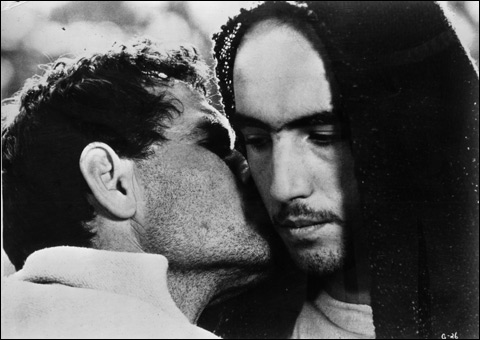
THE GOSPEL ACCORDING TO ST. MATTHEW: The Marxist subtext couples with a meditative stillness that builds to an epiphany. |
The career of Pier Paolo Pasolini begins in the wasteland of Accattone (1961) and ends in the inferno of Salò (1975). Perverse, graphic, and despairing, his films are some of the most humane in cinema. A Marxist and a homosexual, he lived his life as an assault on the status quo; it ended in 1975, allegedly at the hands of a male prostitute, though evidence has been adduced to suggest he was the victim of a right-wing conspiracy.| “The Complete Pier Paolo Pasolini” | Harvard Film Archive: September 3-27 |
But the films endure. They are fevered explorations of the extremities of experience violating the norms of taste, propriety, and æsthetics, yet cleaving in form and meaning to the oldest myths and rituals. This perverse traditionalism was evident in Pasolini's work from the beginning. ACCATTONE (September 10 at 7 pm) is the story of a Roman pimp (Franco Citti) who squeezes his meager livelihood from the weak and innocent. His refusal to work is a half-conscious non serviam to the slavery of society. Instead, he embraces death, becoming a scapegoat sacrificed to the powers that be. This theme — the sacrifice of youth to age, outcast to tyrant, child to parent — recurs in Pasolini's films with the obsessiveness of a nightmare or a rite.His films draw on the West's most familiar stories. THE GOSPEL ACCORDING TO ST. MATTHEW (1964; September 4 at 7 pm) tells the tale of another indigent. Unlike the loser from Accattone, the Christ of this Gospel suffers not in eloquent inarticulateness but in words and deeds that subvert the social order. Although Pasolini remains faithful to the original text, his Christ (played by Enrique Irazoqui, a student from Barcelona) stirs crowds like a revolutionary, and the Marxist subtext couples with a meditative stillness that builds to an epiphany. Everything, including miracles, occurs with blunt literalness but also shimmers with immanence. And so the blunt Crucifixion and the threadbare Resurrection pierce ideology and open into something deeper.
Pasolini further probed this archetypical realm in adapting tragedies and myths that predate Christ in his OEDIPUS REX (1967; September 3 at 9 pm) and MEDEA (1969-'70; September 5 at 7 pm). In Oedipus Rex, the inhabitants of a surreal desert duel with weapons resembling huge bottle openers in costumes that look like lawn furniture to a soundtrack that ranges from Mozart to tribal chants. These trappings veil the tale's theme: the human desire for thoughtlessness countered by the inevitability of knowledge. Franco Citti's King Oedipus is not much different from his Accattone; given to spasms of rage and terror, he stumbles to his fate.
The same is true of Jason in Medea, though in his case, fate is more the fruit of his own ambitions and conscious will. Jason heads off with the Argonauts to Colchis, seeking the Golden Fleece, and finds there a place a bit more primitive than what he's accustomed to. In an elaborate setpiece reeking of James Frazer's The Golden Bough, the high priestess Medea (Maria Callas in her only film role, a non-singing one) sacrifices a male victim to the harvest. For Colchis is the realm of the pagan sensibility that Oedipus has been unwillingly expelled from and that the modern Jason only dimly recognizes. Jason steals the fleece, abetted by Medea, who covers their tracks by butchering her brother and tossing the pieces into the path of the pursuing army. But then Jason abandons Medea and the two sons he has fathered by her. Enraged, she recalls her lost power and exacts a hideous revenge.
 Related
:
Cursed films, Camera obscura, Burden of dreams, More 
- Cursed films
At some point while watching the features in the Harvard Film Archive's "Le Film Maudit" ("cursed films") series — perhaps during the "Circle of Shit" chapter in Pier Paolo Pasolini's SALÒ, OR THE 120 DAYS OF SODOM — you might ask yourself, which is more cursed, the movies or anyone unfortunate enough to be watching them?
- Camera obscura
An acquired taste in French cinema, Philippe Grandrieux is an abstractionist who does narrative features, a post-punk artiste as comfortable making Marilyn Manson music videos as he is war-zone documentaries. But his three major features — which the Harvard Film Archive is screening this weekend and next — revel in a dangerous minimalism.
- Burden of dreams
As the title of Siegfried Kracauer's landmark book From Caligari to Hitler puts it, the politically shaky, culturally fertile Weimar Republic lasted roughly from Robert Wiene's nightmarish Expressionist allegory The Cabinet of Dr. Caligari (1920) to the establishment of the all too real Third Reich in 1933.
- Buñuel continues to delight, confound, and shock
Openly, contentedly delighted with how our own dreams can appall us, and how close movies are to that appalling dreaminess, Luis Buñuel — the subject of an extensive survey at the HFA this month — may have been the greatest filmmaker of the medium's first century.
- Review: Dust
German documentarian Hartmut Bitomsky likes to make movies about how things are put together and how they come apart.
- Review: Petition
This distressing documentary explores a netherworld of individuals who have come to Beijing from all over China hoping that their grievances against their local governments will be heard.
- Bigger than legend
Whatever truth may still come through the legend of Nicholas Ray — America's cinema poet of outlaws, outsiders, and adolescents, a self-destructive artist ruined by alcohol, drugs, and being too good for Hollywood — it's no longer a truth that Ray needs.
- Days of future past
Science-fiction films have been with us since Edison’s 1910 version of Frankenstein , but they bloomed in the ’Nam era, nourished by a volatile cocktail of cultural ingredients.
- Review: Dogtooth
Home schooling takes a hit in Greek director Giorgos Lanthimos's bizarre, chilling parable.
- Naked truth
The George Kuchar renaissance that began with the release of Jennifer M. Kroot's affectionate documentary detailing "the 8mm Mozarts," George and his twin brother Mike, builds to a climax this weekend when the Harvard Film Archive welcomes George.
- In the realm of Oshima
The HFA looks back at the bad boy of Japanese cinema
- Less

Topics:
Features
, Pier Paolo Pasolini, MEDEA, Harvard Film Archive, More
, Pier Paolo Pasolini, MEDEA, Harvard Film Archive, Harvard Film Archive, Arabian nights, Salò, Christ, Oedipus Rex, Less
