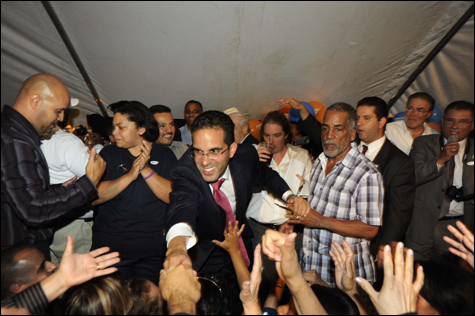
THE WOW FACTOR Lack of polling added to the impact of Taveras’s landslide victory. |
Call it the paradox of Rhode Island’s primary season: the results were no great surprise, but they still managed to raise some eyebrows.
At work here, as communications consultant David Preston noted in a day-after-the-election email, was an absence of reliable public polling.
The problem was particularly pronounced in the Providence mayor’s race. When the contest took shape in the spring, the conventional wisdom had lawyer and progressive darling Angel Taveras replicating outgoing Mayor David Cicilline’s East Side-South Side coalition and cruising to victory over his more traditional opponents.
But there were no public polls in the race. And in the final weeks of the campaign, as rivals John Lombardi and Steven Costantino ramped up their ground operations, an information-starved political class came to believe that the contest was tightening.
It was not. Taveras racked up an impressive 49 percent of the vote, to 29 percent for Lombardi, 20 percent for Costantino, and less than 2 percent for perennial candidate Christopher Young.
Lisa Churchville, general manager of WJAR-TV, says media outlets declined to conduct polls in many of the races for a host of reasons. Among them: getting an accurate sample in, say, a mayoral tilt bound to attract just a few thousand voters can be difficult; and paying for surveys when viewers seem less-than-engaged in the political season is not the wisest of investments.
“It was a low-key primary — it sure wasn’t Delaware,” she says, referring to a hotly contested Senate primary in that state.
Whatever the reason, Rhode Island’s pundit class was left flying blind as Primary Day approached. In the attorney general’s race, State Representative Peter Kilmartin’s victory came as no great surprise. But rival Stephen Archambault’s impressive surge in the final weeks of the campaign — he finished with 33 percent of the vote to Kilmartin’s 40 percent — went largely unnoticed.
In the 1st Congressional District race, Cicilline’s victory over rivals Anthony Gemma, David Segal, and Bill Lynch was widely expected. But the only public polling — a Brown University survey on the race from late July which gave Cicilline a comfortable margin — was out of date by election time. And Cicilline’s opponents had legitimate gripes with the polling methodology.
In the end, the survey predicted the winner, but it was well off the mark in gauging the support of the also-rans. Lynch was second in the Brown poll and last on Primary Day. Segal’s support, less than 6 percent in the poll, was just over 20 percent when it mattered.
THE GAY "BRADLEY EFFECT"?
Media sources say we can expect more polls in the general election.
And the early surveys could play an important role in shaping the final showdown for the 1st District Congressional race, pitting Cicilline against Republican State Representative John J. Loughlin II.
If Loughlin can demonstrate that he has a shot at upsetting Cicilline in a heavily Democratic district that could mean more media attention and — just as important —conservative money from outside the state.
But will the polls accurately gauge Loughlin’s support? Or might a gay “Bradley effect” distort the numbers?
