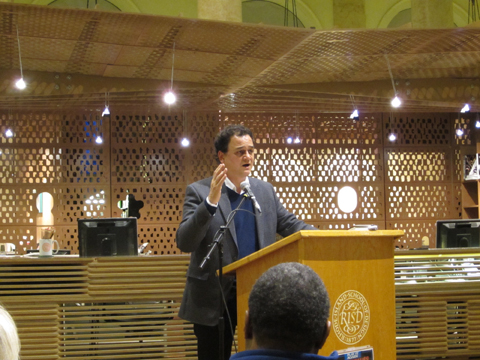
'BUILDING THE BRIDGE' Fox. |
If there are partisan grumblings at the Rhode Island School of Designs's Fleet Library amid Speaker of the House Gordon Fox's "History of Motown" lecture, they're drowned out by the music.
Before Fox takes the podium, tunes like the Supremes' "Baby Love" and "Stop! In the Name of Love" pipe from nearby speakers, while the crowd happily sways, snaps, claps, and shimmies. (Compilation CDs stamped with Fox's face are sold for $10 outside the library to benefit the event's organizer, the Rhode Island Black Heritage Society.)
As the presentation begins, guests nod and murmur "Mmmhmm" when Fox reminisces about his mother's Saturday house-cleaning marathons, when she would crank up the stereo and whirl about. They laugh when he says, "Even today, I must admit . . . there are those days — reps, block your ears — when there's contentious debates going on, in my mind, I can hear Diana [Ross sing], 'Where Did Our Love Go?'"
And many go moist-eyed when the speaker, asked about Motown's power to cross racial lines, again summons his 1960s childhood in Mount Hope, the son of a white father and a black mother. "I am a literal representation of integration," he says. He ticks off childhood memories about Freedom Rides and the assassinations of Martin Luther King Jr. and Robert F. Kennedy. "I mean, here I was at that time, I was seven years old — the world was coming to an end," he says, "but ultimately, there were shards of hope." The Supremes — a group Fox calls "my girls" — were one of those bright spots.
"Here you have three beautiful black women, clad in sequins, wigged up [with] perfected coifs, the moves and whatnot, being allowed into the bedrooms, the living rooms, and entrusted to little white boys and little white girls, decreasing the threat, building the bridge," Fox says. "And I don't know for sure, but I think those children that watched those three ladies up there doing their thing and looking fine are somehow better than their parents." His voice wavers, then he continues. "And that's a beautiful thing."
But the lecture isn't all so somber. During the Q&A session following the speaker's remarks, state Superior Court Judge Edward Clifton raises his hand and, as if quoting a long-established statute, says, "Most of us believe that there is one song that we sing better than the artist." Which tune, he asks, does the speaker sing better than the pros?
There is a pause.
From the row in front of Clifton, Congressman David Cicilline calls out, "I'm tweeting your answer, Gordon!" His iPhone is poised and ready.
Then, after another moment, the Speaker leans into the microphone and says, "What Becomes of the Broken Hearted?"
