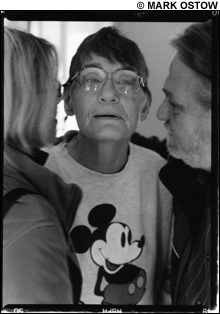
 This Friday, February 24, is Margaret Rouleau’s 77th birthday. It will mark the 56th year she has lived at the Fernald Developmental Center in Waltham, a state-run facility for people with developmental disabilities and mental retardation. Rouleau is severely mentally disabled; she also suffers from diabetes and scoliosis, is blind in one eye and deaf in one ear, and has survived breast cancer. But she loves music and has a strict work ethic; when we meet one Tuesday morning in February, she informs me several times that she really has to get back to her job at a Fernald workshop, where she and other residents are contracted to assemble health-care kits for the state Department of Public Health.
Since she was 19 years old Rouleau’s life has been one of routine, which has enabled her to enjoy her days, learn job skills, and contribute to the world economically. But today, she is one of 198 remaining Fernald residents whose futures are uncertain, because if Governor Mitt Romney (along with some state officials, and a sizable group of disability advocates) has his way, her home will be shut down.
Dorothy Rouleau, Margaret’s sister, is energetic and chipper, but when conversation turns to the subject of Margaret’s possible move, she sobers. This is Margaret’s home, she says, and anywhere else the state might place her would act merely as four walls. “They can’t take them from a home and put them in a shelter.” Dorothy says. “This home is full of love.”
Rouleau might not be able to stand up for herself, but a group of fiery activists is making sure that Fernald doesn’t go down without a fight.
At stake is not only the future of these individual souls who have grown accustomed to Fernald and call it home, but the future of the state-institutional system that has stretched and improved over time to treat cases like theirs.
Critics contend that smaller-scale, community-based care fosters independence, social acceptance of disabilities, and medical innovation. But Fernald residents and their guardians fear that the greater flexibility of that model, combined with the initially jarring transition out of institutional care, would leave disabled citizens floundering without the continuity and individualized care they need.
Checkered past
The Fernald Center, founded in 1848, is the oldest institution of its kind in the Western Hemisphere, and its history is as checkered as it is long.
The center was established as a state school for the retarded, and at its peak, in the 1960s and ’70s, more than 2000 “state boys” and “state girls” lived on its 196-acre grounds — a number that has dwindled to 198 today.
