US troops are killing themselves in record numbers
By JASON NOTTE | March 17, 2009
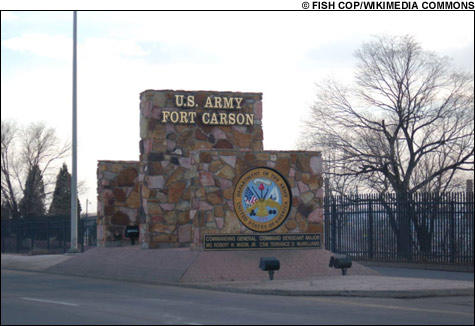
FORT HELL: Retired Army staff sergeant Andrew Pogany suffered from hallucinations and panic attacks while on active duty in September 2003 — the result, he says, of mandatory medication administered by the military. Since then, 17 of his fellow servicemen from Fort Carson, Colorado, have committed suicide. |
Upon returning from Iraq, 23-year-old Marine Lance Corporal Jeffrey Michael Lucey suffered episodes of such intense war-induced rage that he'd often need to be consoled by his parents, who would rock him back to normalcy in their laps. On July 22, 2004, unable to handle the intensity anymore — the daily vomiting, the feeling that he was a murderer, the fear that none of his military higher-ups even cared — Lucey wrapped a garden hose around his neck in the basement of his family's Belchertown, Massachusetts, home and hanged himself.During his last visit to the Northampton VA Medical Center in Leeds for Post-Traumatic Stress Disorder (PTSD) — a three-day stint in the hospital's psychiatric ward almost six weeks before he killed himself — Lucey had been prescribed a number of antipsychotic drugs, including Klonopin, Ativan, and Haldol. He was also given warnings that they not be taken with alcohol. Two days after his release, he destroyed his parents' car in an apparent suicide attempt. A little more than a month before he killed himself, say his parents, Kevin and Joyce Lucey, he was refused mental-health treatment by the Department of Veterans Affairs (known as the Veterans Administration until the late 1980s, but still commonly referred to as the VA) because he'd been drinking heavily. The Luceys insist that the VA focused on a symptom (the drinking) instead of the actual cause of his mental deterioration: PTSD.
In January 2008, the Luceys were awarded a $350,000 settlement from the VA, which admitted no wrongdoing in their son's suicide. This past Thanksgiving, the Luceys were once again left with an empty seat at the table and emptiness in their hearts. A few days before the holiday, they distributed a letter through the non-profit organization Veterans for Common Sense, which used Lucey's story as a cautionary tale for other veterans and their families.
Another front has opened in the wars being fought by the US military, and it is one for which the Pentagon was as unprepared as it was for the conflicts in Iraq and Afghanistan. The primary (though not the only) enemy is PTSD, and to fight it, US troops are desperately being prescribed a wide array of medicines, from anti-depressants to anti-anxieties. They are also self-medicating in numbers beyond the control of the Department of Defense (DoD) or the VA, and the military has failed to provide adequate long-term treatment and follow-up care. As a result, as we recognize this week the sixth anniversary of the start of the war in Iraq, America's troops both in that conflict and in the one in Afghanistan are literally fighting their wars on drugs — and a record number of both active troops and discharged veterans are committing suicide.
 Related
:
Culture wars, When GI Joe says no, Pop goes to war, More 
- Culture wars
American anthropologist Paula Loyd was in Afghanistan, discussing living costs with a local man when suddenly he doused her with fuel from a jug he was carrying and set her on fire.
- When GI Joe says no
A young former US Army sniper wearing a desert-camo uniform, an Iraqi kaffiyeh, and mirrored sunglasses scans a ruined urban landscape of smashed homes, empty streets, and garbage heaps.
- Pop goes to war
Next time you put on the new Spoon single to make that subway ride go by a little faster, consider what musical escapism means to troops in Iraq.
- Getting out
- Iraq + surge = ???
Certain that the newly elected Democratic Congress will not end American involvement in the Iraq War, Rhode Island peace movement leaders are calling for additional demonstrations to bring US troops home.
- The Host
Running a rubber-gloved finger across gallons of dust-covered bottles of formaldehyde, a US military official orders a Korean morgue attendant at a US Army base in Seoul to “empty every bottle to the very last drop.
- Sex, Iraq, and pop culture
How many times a day do you think about sex? How many times a day do you think about the war in Iraq?
- Gulf War vet 'saved' by Phoenix article
Yesterday, we published "Soldiers Committing Suicide," by Jason Notte, and just hours later, Mike Fitzgerald left our Portland editor a voicemail saying he's experiencing the same things a man described in the story had.
- Collateral damage?
Was Hasan suffering from PTSD?
- Candidates' stances on the war in Iraq
- Debating the Middle East muddle
US military aid to Pakistan and Afghanistan is being wasted and should be redirected to the police and moderate non-violent groups working for education and the rule of law, according to two Middle East experts who spoke Sunday at the Community Church of Providence.
- Less

Topics:
News Features
, Politics, Health and Fitness, Post-Traumatic Stress Disorder, More
, Politics, Health and Fitness, Post-Traumatic Stress Disorder, Mental Health Treatments, Joseph Stiglitz, Military and Defense Policy, World Health Organization, Afghanistan War, Ambien, Insomnia, Less
